
When implementing blockchain, PhD scholars can transform their research ideas into working, experimental, and measurable systems. Ondezx provides customised implementation support across diverse research domains, including cybersecurity research, Internet of Things (IoT), healthcare, financial and banking systems, supply chain, smart cities, cloud computing, e-governance, and other emerging areas.
For researchers, developing proposed algorithms into functional code, determining the most appropriate architecture for implementation, setting up experimental environments, reproducing results published in existing literature, and assessing system performance can be challenging. Our technical implementation support helps scholars address these challenges with a structured and research-focused approach.
Ondezx has experts with expertise in both PhD-level research methodology and technical development, delivering customised support based on the specific requirements of each research project. The process can begin with identifying the research problem and selecting an architecture suitable for the research, followed by development, testing, evaluation, documentation, and refinement.
Creating a working blockchain application is just a portion of the implementation of successful PhD research. The solution should be related closely with the research goals, proposed research method, experimental needs, and assessment. Our Blockchain Implementation Solutions offer the researchers tailored technical assistance, emphasizing the transformation of their research ideas into workable, testable, and research-oriented blockchain implementations.
Research-Centred Development: Our development approach is based on investigating the research problem, goals, hypotheses, methodology and anticipated results of the experimental activities. Each decision made in the implementation is based on the individual scholar's research needs.
Customised Implementation: We implement blockchain systems according to the proposed architecture, algorithms, datasets, parameters and technical specifications given by the scholar. This way, the implementation will be relevant to the research and not based on a standard solution unrelated to the research.
Algorithm-to-Code Translation: Functional and executable modules can be created for proposed algorithms, mathematical models, consensus mechanisms, validation procedures and security techniques. This allows researchers to implement and evaluate their research design ideas in real life.
Controlled Experimental Setup: We create appropriate experimental settings to evaluate various parameters, workloads, transaction conditions, network settings, and baseline methods. This facilitates systematic experimentation and dependable research results.
Full Implementation Evaluation: Support for the evaluation of the implemented system with the appropriate research metrics like throughput, latency, transaction processing time, scalability, resource utilisation, storage overhead, accuracy, security parameters etc. These measurements can be used as a data point for research analysis and comparison.
Professional Technical Documentation: We offer well-documented reports and materials for the development decisions, system architecture, implementation procedures, testing conditions, experimental results and system limitations. This documentation can be used for research papers, dissertations, presentations and viva.
Through a research-oriented methodology, tailored development approach, hands-on testing, and systematic assessment, our implementation support of blockchain enables researchers to convert their envisioned ideas into practical, research-driven and experimentation-backed blockchain systems.
Research objective, the proposed architecture, the experimental requirements, and the implementation environment determine the technology stack. Based on your project requirements, we use suitable technologies to build, test, validate, and evaluate the proposed implementation effectively.
The final technology stack you will end up with depends on your research needs and every technology for which you choose an implementation purpose. In particular, if the research architecture is already using Java or needs to be integrated with an existing Java environment, the implementation in Java may be a good option.
Likewise, blockchain solutions can be tailored according to smart contracts, decentralised applications, IoT devices, cloud services, APIs and other elements that are needed by your research methodology. We center on a pragmatic and research-based tech stack, not an unnecessary one that you have to employ.
Our blockchain implementation support helps researchers develop practical, research-focused solutions tailored to specific technical requirements and academic objectives. Our service provides distinguished blockchain research implementation support for your service.
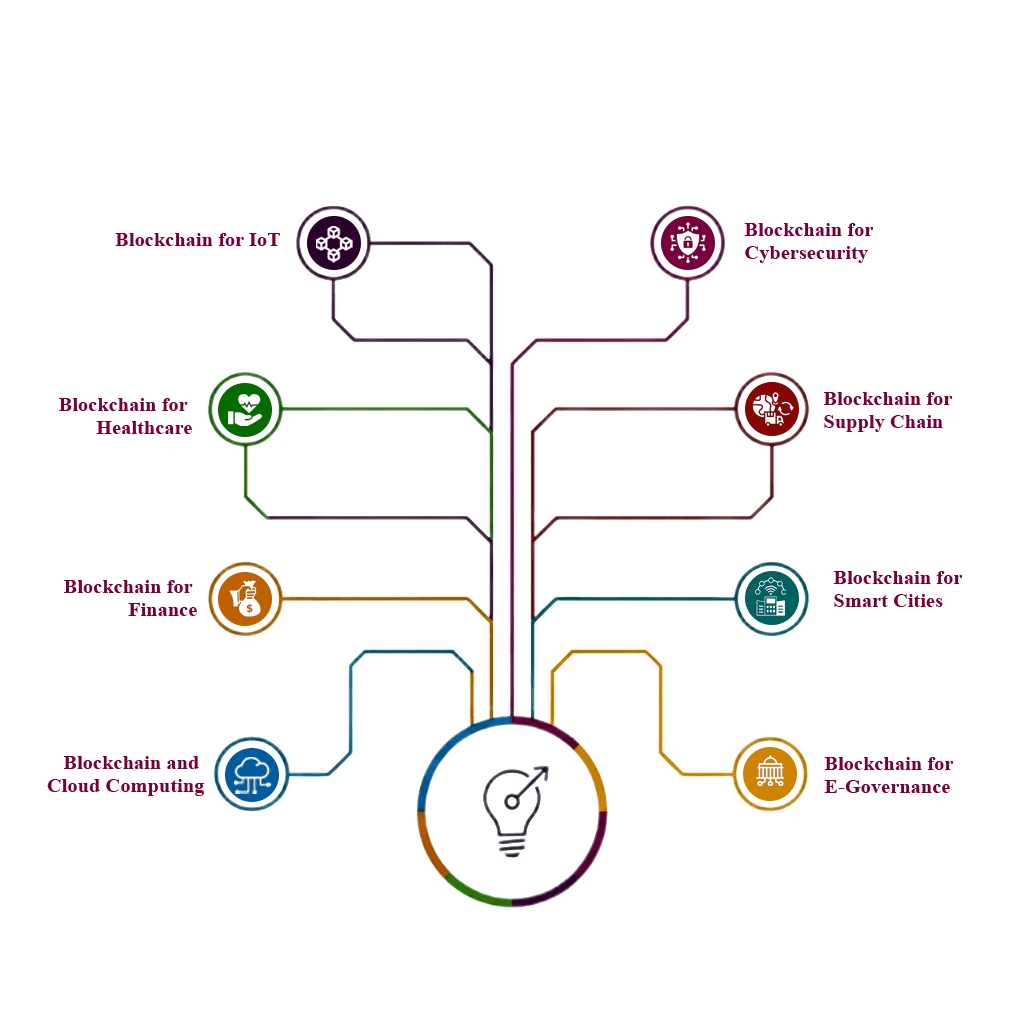
We support blockchain implementations for cybersecurity research covering decentralized authentication, digital identity management, access control, secure data exchange, and threat detection. Research implementations could study the enhancement of trust, integrity and accountability between entities involved in the participation.
Our Blockchain for IoT Implementation support helps researchers explore secure and decentralised management of connected devices. Implementations can address device authentication, secure communication, decentralized data management, access control, and transaction validation while considering the resource limitations of IoT environments.
We provide customised blockchain implementation support for healthcare research focused on medical data security, patient identity verification, privacy protection, data integrity, and access control. Researchers can build experimental systems to evaluate secure data sharing between healthcare stakeholders while analysing performance, efficiency, security, and scalability.
Our Blockchain for Supply Chain Implementation enables researchers to develop practical models for product traceability, provenance tracking, transaction transparency, and data verification. Supply-chain participants such as manufacturers, suppliers, distributors, and retailers can be incorporated into the implementation to study how blockchain improves visibility, trust, and accountability.
We support blockchain implementations for financial research involving transaction processing, smart contracts, transaction validation, fraud detection, and financial data management. Researchers can evaluate transaction speed, validation time, security, throughput, and scalability under different workloads and experimental conditions.
Our Blockchain for Smart City Implementation support helps scholars investigate decentralised solutions for identity management, transportation, energy management, infrastructure monitoring, and secure information sharing. Implementations can explore the impact of decentralized coordination on trust, data integrity, and system performance.
We provide implementation support for research combining blockchain and cloud computing across areas such as distributed storage, authentication, access control, resource sharing, and data security. Blockchain solutions can be integrated with cloud-based experimental environments to help researchers assess security, performance, resource utilisation, and scalability.
Our Blockchain for E-Governance Implementation support enables researchers to explore blockchain applications in document verification, digital identity, secure record management, transparency, and government service delivery. Research prototypes can be developed to evaluate verification efficiency, accountability, data integrity, transparency, and controlled access to administrative information.
We provide blockchain implementation support that enables researchers to replicate published research and test if they could get similar results if they were to apply similar experimental conditions. The first step is a careful review of the selected research paper, where architecture, algorithms, parameters, datasets, experimental environment and evaluation methods are discussed.
We then convert the published methodology into a working prototype as close as possible to the original technical process. This serves as a practical basis for experimentation, validation and comparison.
Further testing and result validation can be done on the reproduced system. If discrepancies are found between published and reproduced results, our implementation process provides a way to investigate potential discrepancies in the data sets, parameters, hardware, software versions, hardware configurations, or experimental conditions.
The reproduced implementation can also serve as a starting point for refinements of the original technique and for a significant research contribution. All of this can then help in the preparation of a research paper that outlines the implementation details, observations in the experiment, comparison and technical limitations.
Each PhD project is in various stages of development and our approach to it is designed to fit your research, technical needs and expected results.
We transform the research idea into a practical blockchain prototype by specifying the requirements of the system, actors involved, architecture and relevant blockchain modules.
We translate your proposed algorithm or mathematical model into executable code maintaining the methodology, input conditions, computational procedures, validation logic and desired outputs.
We bring the necessary parts together to create an existing blockchain architecture into a working system, including adding databases, smart contracts, APIs, interfaces and communication layers.
Existing blockchain code is modified to accommodate optimization, new functionality, implementation corrections, or implementation-specific experiments and their impact on relevant research performance metrics is evaluated.
We implement a published blockchain research method, including its architecture, algorithms, parameters, datasets, and evaluation procedures, in a manner that mirrors it, so that we can compare and contrast with the reported results.
We incorporate your suggested improvement in an existing blockchain model and benchmark it against the baseline, and we use consistent datasets, workloads and experimental conditions and performance measures to show the value of your research.
The success of a research implementation should be: A connection between research problem and a technically feasible and experimentally measurable solution. Ondezx assists PhD students on the implementation path, from idea analysis (for research), selection of architecture, coding, testing, performance evaluation, documentation and refinement.
Our tailored PhD research support is based on the scholar's chosen methodology and not a one-size-fits-all approach. It's possible to identify appropriate technologies, convert proposed algorithms into executable modules, set-up research experiments, and arrange technical findings for academic reporting with the help of PhD qualified experts.
Implementation can be linked to your objectives and evaluation requirements, whether you are looking for blockchain implementation in java, blockchain implementation in supply chain research, smart-contract development, paper reproduction, modifying existing codes or building a research prototype.
Yes. Analysis of published architecture, algorithms, datasets, parameters, experimental setups and evaluation methods can be included in research paper reproduction.
Yes. The algorithm or mathematical model that has been created in a research can be written as executable code based on the research logic, input parameters, processing steps and output of the research.
The platforms can range from Ethereum, Hyperledger Fabric, Polygon, Corda, and others as per the research needs.
Yes. The existing code can be modified, optimized, debugged and extended as per the proposed research needs of the scholar.
The evaluation is based on the research objective. Throughput, latency, transaction processing time, scalability, resource utilization, storage overhead, accuracy, computational cost, security measures are common parameters.
Yes. Technical documentation may include description of the system architecture, technology selection, algorithms used, implementation procedures, experimental configurations, testing methods, performance metrics, results obtained, limitations, refinement stages, etc.