
Viva voce preparation at Ondezx is designed to help research scholars approach their final defense with confidence and clarity. Our expert support focuses on strengthening your thesis presentation, preparing you for examiner questions, and improving the way you communicate your research.
After years of research, writing, revisions, sleepless nights, and endless feedback rounds, many PhD scholars expect to feel relieved once their thesis is submitted. For many researchers, the PhD viva voice feels intimidating because it is deeply personal. Your thesis is no longer just a document on paper. Suddenly, every argument, methodology choice, citation, and conclusion becomes part of a live academic conversation.
A successful viva is about sounding perfect or memorising textbook answers. It is about understanding your research deeply enough to explain and defend it with clarity and confidence. This is where a structured viva voce preparation service can make a real difference, helping scholars organise their thoughts, practise responses, and walk into the examination room feeling prepared instead of overwhelmed.
By the end of this guide, you will understand how to prepare effectively for your PhD viva voce and how our expert support can help you approach the process with far greater confidence.
The term “viva voce” comes from Latin and means “with living voice.” In simple terms, it is an oral examination where a PhD scholar defends their research before a panel of academic examiners.
It is also commonly referred to as a thesis defense or oral defense. Universities across India, the UK, Europe, and many other countries require this stage before awarding a doctoral degree.
In most cases, the viva lasts between one and three hours, though highly technical or interdisciplinary research can sometimes take longer.
According to the UGC PhD Regulations, Indian universities are required to include an oral evaluation component as part of the doctoral assessment process.
A typical viva panel may include:
An internal examiner from your university
An external examiner from another institution
Your research supervisor (usually as an observer)
A chairperson or convener in some universities
Institutions such as Anna University and the University of Madras follow UGC-guided procedures for examiner appointments and viva conduct.
Although the structure sounds formal, the viva is essentially an academic discussion focused on your research contribution.
Many PhD scholars prepare independently for their viva, but structured expert support can often make the process less stressful and more effective. Our professional viva voce preparation service focuses not only on your thesis content but also on how confidently you communicate your research under pressure.
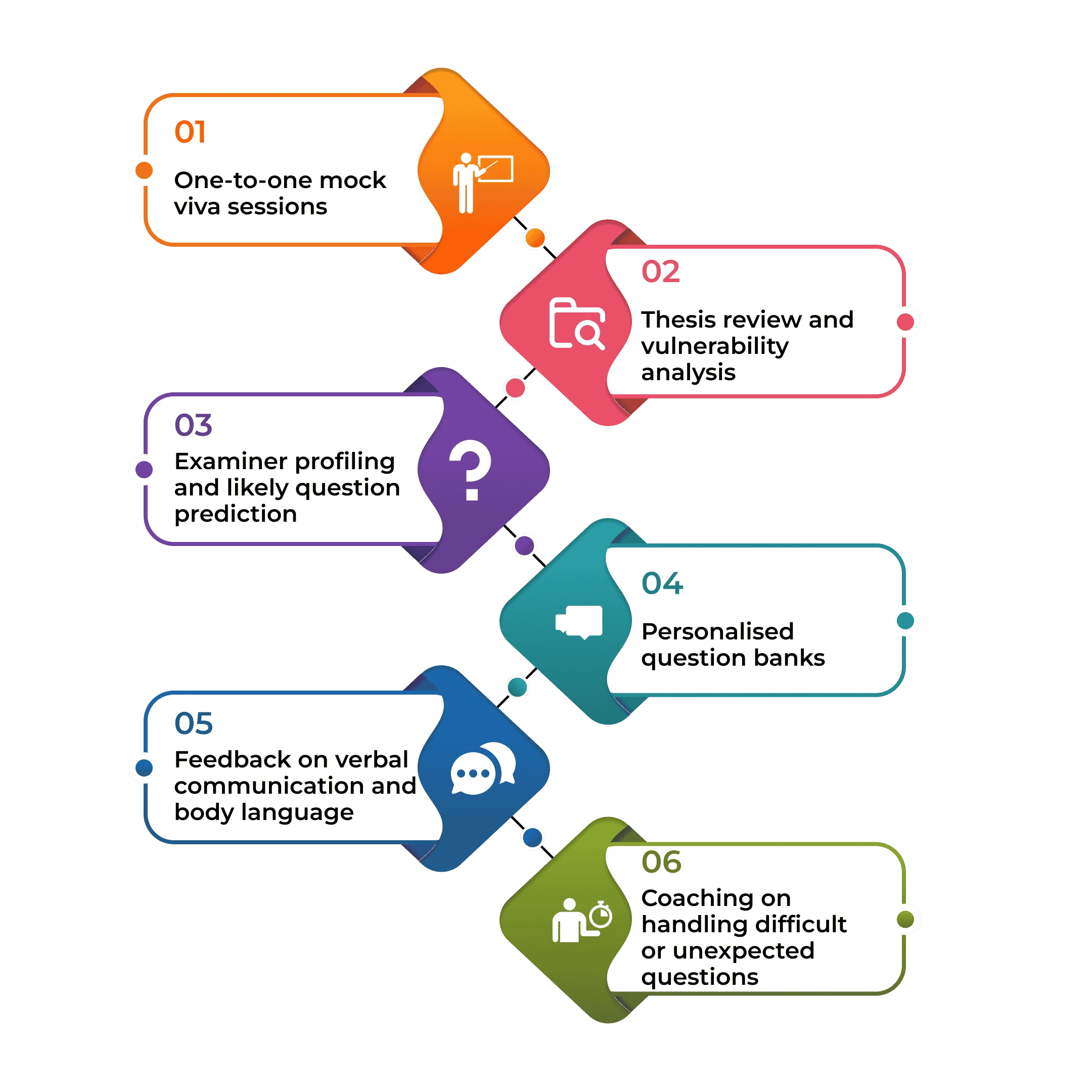
A structured preparation service may include:
One-to-one mock viva sessions
Thesis review and vulnerability analysis
Examiner profiling and likely question prediction
Personalised question banks
Feedback on verbal communication and body language
Coaching on handling difficult or unexpected questions
The goal is not to memorise answers, but to improve clarity, confidence, and response structure.
Professional preparation can be especially useful for:
Scholars with limited supervisor availability
International students unfamiliar with viva culture
Candidates facing resubmission or major corrections
Researchers with highly technical or statistical work
Scholars preparing for high-stakes institutional vivas
Even strong researchers often struggle with verbal defence if they have not practised in realistic conditions.
Aspect |
Self-Preparation |
With a Preparation Service |
|---|---|---|
|
Mock sessions |
Limited peer practice |
Multiple structured mock vivas |
|
Question coverage |
General |
Thesis-specific preparation |
|
Examiner insight |
Minimal |
Research-based analysis |
|
Feedback quality |
Broad and informal |
Detailed and actionable |
|
Confidence building |
Inconsistent |
Progressive and measurable |
Alongside viva support, Ondezx also offers:
The Fear Is More Common Than You Think
Even highly capable researchers feel anxious about the PhD viva voce. The fear usually comes from uncertainty rather than lack of knowledge.
Your research design
Data interpretation
Methodology choices
Theoretical framework
Statistical analysis
Limitations of the study
Many scholars worry about being caught off guard by a difficult question or forgetting something important under pressure.
Unlike writing a thesis, where you have time to revise and rethink, the viva demands immediate responses. That alone makes the experience emotionally intense.
One of the biggest problems is that doctoral candidates are rarely trained to defend research verbally.
Conduct studies
Analyse data
Write academically
Publish papers
Our guidance on how to explain complex research confidently in a live discussion.
Academic confidence
Real-time questioning
Public speaking anxiety
Structuring concise answers
Handling criticism calmly
Major corrections
Delayed graduation
Resubmission requirements
Increased stress and burnout
In some cases, candidates spend months revising issues that could have been addressed through proper preparation beforehand.
This is why mock vivas and structured practice sessions have become increasingly important for doctoral scholars worldwide. We help PhD scholars navigate their research journey with confidence through expert academic support and focused viva voce preparation designed for successful outcomes.
One of the first things examiners assess is whether the candidate truly understands the research beyond what is written in the thesis.
Why did you choose this method?
Why was this theory important?
Why did you exclude certain variables?
Why do your findings matter?
A strong candidate explains decisions naturally instead of sounding memorised.
Examiners do not expect a flawless thesis. What they do expect is intellectual maturity.
Acknowledge limitations honestly
Discuss alternative viewpoints
Defend decisions logically
Accept constructive critique professionally
Trying to “win” every argument usually creates more tension. Calm academic reasoning leaves a much stronger impression.
Your communication style influences how your expertise is perceived.
A confident PhD viva voce presentation is not about speaking fast or sounding overly technical. It is about explaining ideas clearly enough that others can follow your reasoning.
Maintaining composure
Speaking clearly
Avoiding rushed answers
Staying focused on the question
Making eye contact
Clear communication often reflects a clear understanding.
Most examiners expect candidates to remain updated on developments published after thesis submission.
How your work compares with recent studies
Whether your conclusions still hold
How your findings contribute to the field overall
That broader awareness demonstrates academic readiness beyond the thesis itself.
Preparing for a viva voce is not something that should begin a few days before the examination. The strongest performances usually come from candidates who prepare gradually, practise consistently, and understand their research beyond what is written on paper. A structured preparation approach helps reduce anxiety and gives you better control during the discussion. At Ondezx, we help research scholars move through every stage of the PhD journey with confidence. From research support to viva voce preparation, we provide expert guidance that helps candidates feel prepared, focused, and ready for success.
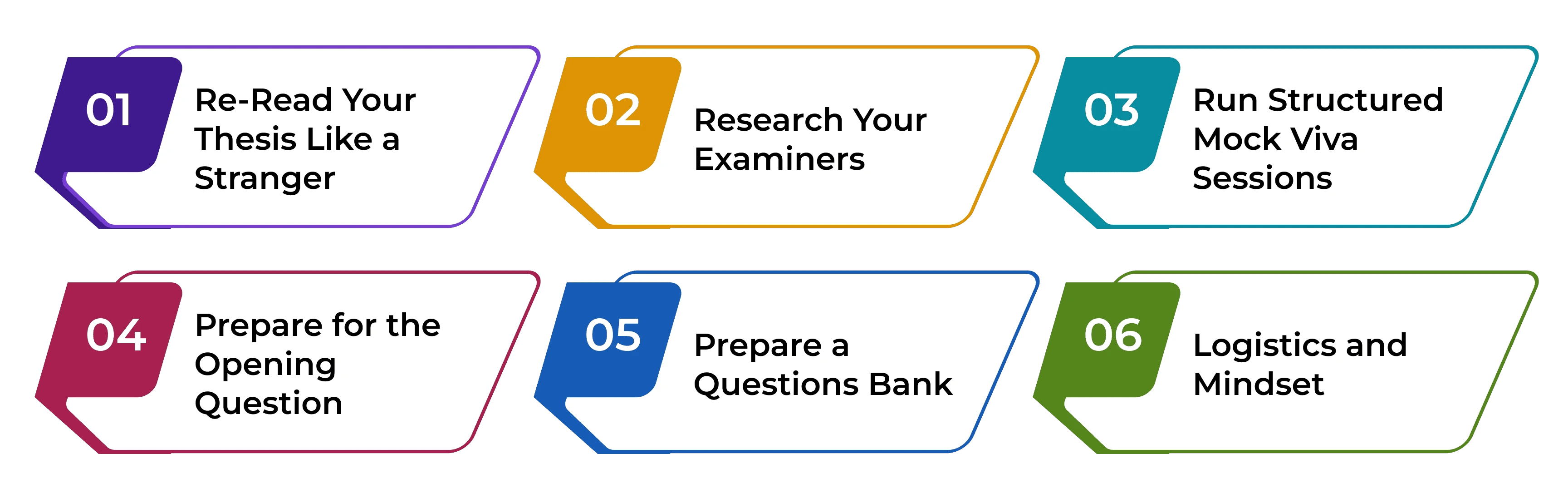
Once your thesis is submitted, take a short break and then revisit it with fresh eyes. Read the entire document at least twice before the viva.
As you go through each chapter, pause and ask yourself:
Why did I make this decision?
Could an examiner challenge this argument?
How would I explain this point verbally?
Pay special attention to your methodology chapter because this is often where examiners focus most of their questions. If there are areas where your writing sounds uncertain or overly cautious, make note of them and prepare clear explanations in advance.
If your university shares examiner details beforehand, spend time understanding their academic background and recent research.
Read:
Their published journal articles
Conference papers
Research interests
Previous work related to your topic
This helps you understand their academic perspective and anticipate the type of questions they may ask. It is not about impressing examiners; it is simply smart academic preparation.
One of the best ways to prepare for a PhD viva voce is through realistic mock sessions.
Arrange at least two or three practice vivas with:
Your supervisor
Senior scholars
Subject experts
A professional viva voce preparation service
Try to simulate real examination conditions as closely as possible. If allowed, record the sessions and observe your body language, clarity, and response structure afterwards.
Most importantly, ask your mock panel to challenge your weakest chapter instead of only focusing on strengths.
Many vivas begin with a simple but important question:
Common opening question
"Can you summarise your thesis in five minutes?"
This opening response sets the tone for the rest of the examination. A good answer should briefly explain:
Research background
Research gap
Objectives
Methodology
Findings
Contribution
Avoid sounding rehearsed. Examiners are looking for confidence and clarity, not memorisation.
Create a list of likely questions from every chapter of your thesis.
Organise them into categories such as:
Literature review
Methodology
Findings
Limitations
Contribution
Future research
Instead of memorising long answers, prepare concise bullet points that help you respond naturally during the viva.
In the final 24 hours before your viva:
Confirm whether the format is online, offline, or hybrid
Organise printed copies of your thesis with sticky tabs
Test your technical setup if the Viva is virtual
Get proper sleep and avoid last-minute cramming
Most importantly, remind yourself that nobody understands your research more deeply than you do. Walk into the room as the expert on your own work.
One reason scholars feel nervous about the PhD viva voce is uncertainty about the questions they might face. While every viva is different, certain themes appear repeatedly across disciplines and universities. Preparing for these areas can significantly improve your confidence.
Examiners often begin with questions about methodology and research decisions, such as:
When answering, connect your decisions back to existing literature and research objectives. Your goal is not to prove that your methodology was perfect, but to show that it was academically justified and thoughtfully selected.
Start with your key finding first, then explain why it matters. Avoid downplaying your work. Examiners want to see that you understand the significance of your contribution.
Many candidates become uncomfortable discussing limitations, but this is actually an opportunity to demonstrate research maturity.
A strong response acknowledges the limitation honestly, explains why it existed, and then discusses how future research could address it.
Preparing two or three realistic future directions shows that you understand the broader academic value of your research beyond the thesis itself.
For many scholars, the most stressful part of the viva is the opening presentation. A well-prepared PhD viva voce presentation helps create a confident first impression and gives examiners a clear overview of your research before detailed questioning begins. From research development to viva voce preparation, we provide tailored academic support that helps scholars prepare effectively, communicate research clearly, and approach the final defence with confidence.
Not always. Some universities begin directly with questions, while others require a formal presentation lasting around 10–15 minutes.
Many Indian institutions, including Anna University and other central universities, often expect candidates to deliver a short presentation before the viva discussion begins.
Presentation duration
Slide requirements
Online or offline format
Whether PowerPoint is permitted
A simple structure works best. Your presentation should clearly guide examiners through the story of your research.
Section |
Approximate Time |
|---|---|
|
Research background |
2 minutes |
|
Research gap & objectives |
1 minute |
|
Methodology overview |
2 minutes |
|
Key findings |
2 minutes |
|
Contribution & conclusion |
1.5 minutes |
|
Limitations & future scope |
1 minute |
Keep transitions smooth and avoid overwhelming slides with too much information.
Strong presentations are usually simple, clear, and visually balanced.
Some useful tips include:
Use minimal text on slides
Include diagrams or conceptual frameworks where possible
Highlight only key points
Maintain consistent formatting
Speak naturally instead of reading directly from slides
Examiners are evaluating your understanding, not your slide design skills.
If your viva is online, technical preparation becomes equally important.
Before the examination:
Test your internet connection
Check screen-sharing functionality
Keep backup devices ready
Ensure proper lighting and audio clarity
A calm technical setup helps you stay focused on the academic discussion instead of avoidable disruptions.
The day of your viva voce can feel overwhelming, but understanding the process beforehand often reduces anxiety significantly. Most vivas follow a fairly predictable structure, even if the questions themselves vary.
Whether your viva is online or in person, aim to arrive or log in at least 15 minutes early.
Printed thesis copy with sticky tabs
Notebook and pen
Water bottle
Presentation slides if required
In many cases, the chairperson or examiner may briefly explain the format and expected duration before the discussion begins.
Opening presentation (if required)
General discussion led by the external examiner
Detailed chapter-based questioning
Opportunity for final comments
Examiner deliberation
Final outcome announcement
Pass
Minor corrections
Major corrections
Resubmission
You are not expected to answer every question instantly or perfectly.
If you need time to think, pause calmly before responding. If you genuinely do not know the answer, it is perfectly acceptable to say:
“That’s an interesting question. While my research did not directly examine that aspect, my findings suggest…”
Similarly, if you disagree with an examiner’s interpretation, respond respectfully and support your reasoning with evidence from your thesis.
Asking for clarification is also completely acceptable and often demonstrates careful academic thinking rather than weakness.
The viva voce is often viewed as the most intimidating stage of a PhD journey, but at its core, it is a structured academic discussion about the research you have spent years developing.
Strong preparation makes a major difference.
When scholars understand their thesis deeply, practise responding to challenging questions, and improve their presentation confidence, the viva becomes far more manageable and significantly less stressful.
Whether you are preparing for your first defence or returning after major corrections, structured guidance can help you approach the examination with greater clarity and confidence.
At Ondezx, our viva voce preparation service connects you with subject-specific PhD experts who review your thesis, conduct realistic mock vivas, and help you prepare strategically for examiner questioning.
Explore our additional academic support services: