Difference Between Thesis and Synopsis: A Complete Guide for Academic Clarity
For many research scholars, the confusion about the difference between thesis and synopsis is completely understandable. In a scholarly journey, both documents serve different purposes and prove the essentiality of academic writing. A synopsis is a short, pre-research proposal, whereas a thesis is a detailed research document that extends one hundred pages. Understanding how these two fit into the broader academic landscape helps researchers plan more effectively and avoid structural or methodological errors along the way.
In this blog, you will explore the purpose, components, structure, academic expectation and difference between thesis and synopsis. As we move through each section, you will gain a clear roadmap on synopsis and thesis, where we determine each of the research and how it contributes to scholarly success.
Understanding the Synopsis: The Blueprint
A summary is the basis of your research process – the map of an action plan that you lay before your entire study.
What is a Synopsis?
A synopsis is a 5–20 page formal proposal submitted to a university or research committee before starting research, outlining the study’s objectives, methodology, and expected outcomes.
-
Demonstrates the viability, relevance, and originality of the research.
-
Provides arguments explaining why the study is necessary.
-
Defines the research problem and presents a clear academic plan for carrying out the project.
Core Components & Tense
The good synopsis has a clear and disciplined structure that makes it clear and academically rigorous. Key elements include:
-
Title
-
Rationale / Background
-
Objectives
-
Hypothesis
-
Tentative Methodology
-
Tentative Chapter Plan
-
References
The methodology section is normally written in the future, e.g., 'The analysis of the data will be done in terms of...' since the work is not yet in progress.
Research design methods literature (e.g., Creswell, 2018) underlines the fact that clear goals and realistic procedures contribute greatly to the acceptance of a PhD synopsis.
Understanding the Thesis: The Masterpiece
When the synopsis is a blueprint, the thesis is the masterpiece of your academic work, where it acts as the complete research evidence. Understanding this difference between thesis and synopsis is more important.
What is a thesis?
A thesis is an elaborate after-study paper (100 pages or more) that reports on original findings supported by high-quality evidence.
-
It is the ultimate result of years of work, and it is also termed a thesis paper.
-
Its key objective is to contribute significantly to knowledge and introduce findings on research that are capable of withstanding critical analysis at the viva voce.
-
When comparing synopsis vs thesis, the thesis is clearly the comprehensive final product of the research journey.
Core Components & Tense
A thesis in research usually has:
Results and Discussion sections are in the past tense, e.g., “The experiment demonstrated... because the research activities are already done.”
Higher education research empirical studies observed that those who have well-constructed methodology statements and clear data reporting score high in terms of academic assessment.
The Key Difference Between Thesis and Synopsis
The most important difference between a thesis and a synopsis lies in purpose, scope and depth. Below is a structured comparison to support quick understanding.
Detailed Comparison Table
|
Element
|
Synopsis
|
Thesis
|
|
Purpose
|
Proposes planned research
|
Presents completed research
|
|
Timing
|
Submitted before research begins
|
Submitted after the full study is done
|
|
Length
|
5–20 pages
|
100+ pages
|
|
Focus
|
Objectives, feasibility, plan
|
Findings, analysis, contribution
|
|
Tense
|
Future tense
|
Past tense
|
|
Literature Review
|
Selective (to identify gaps)
|
Comprehensive (to map the field)
|
|
Methodology
|
Tentative steps
|
Executed procedures
|
|
Outcome
|
Approval for research
|
Degree award requirement
|
This comparison aligns with guidelines from academic bodies such as UGC, APA, and international doctoral standards.
Methodology: Theory to Practice.
A synopsis in one line defines what you intend to do, and the thesis in one line defines what has actually been done.
The synopsis includes
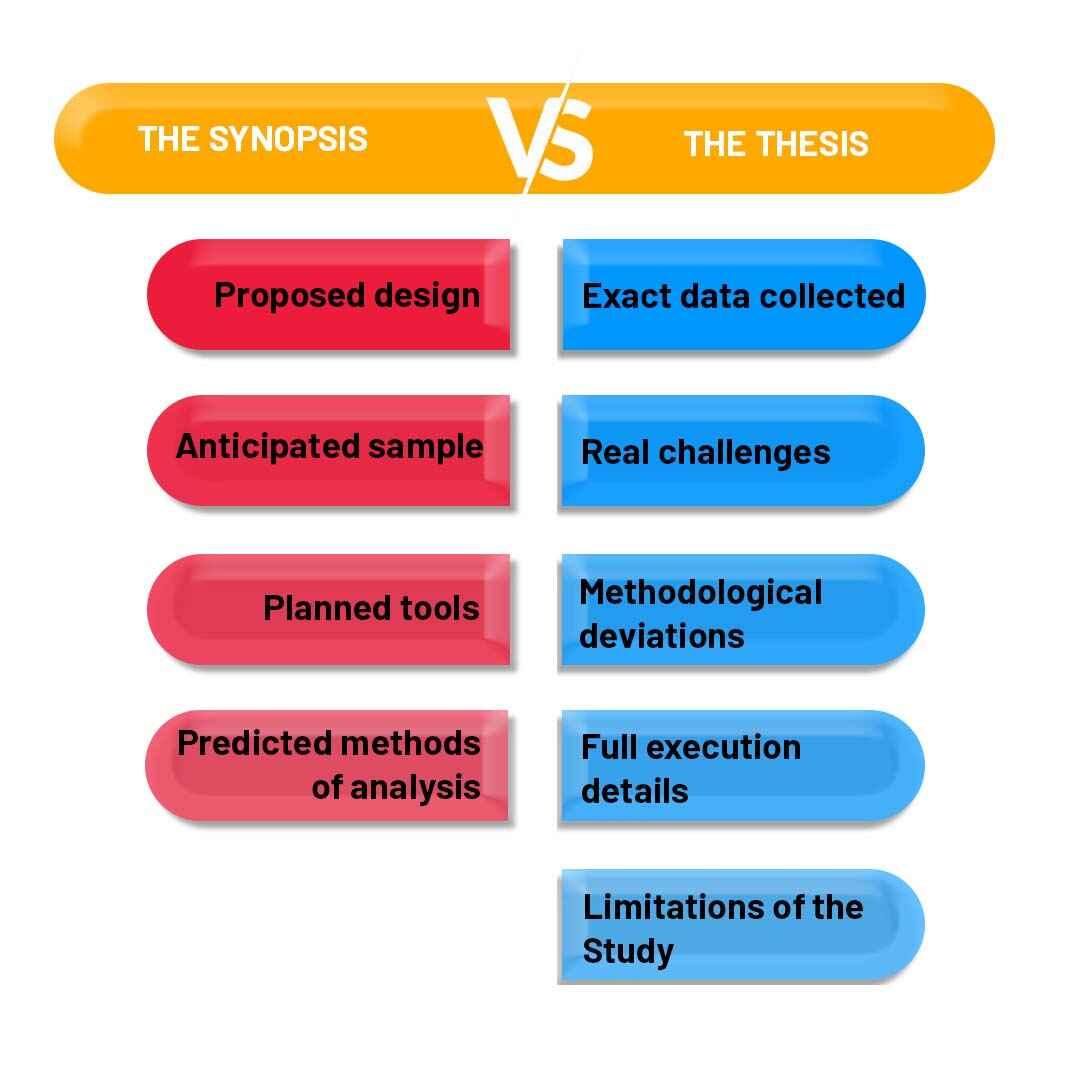
The thesis includes:
A clear transition between synopsis and thesis is an indicator of a research project that is in together with itself.
Literature Review Depth
In the literature review, the difference between thesis and synopsis is even more obvious.
-
The literature review is also selective in the synopsis, as it is concerned with gap identification.
-
The literature review in the thesis is vast, tracing theoretical underpinnings, approaches, issues and areas of concern.
Eg: Studies on graduate writing standards (e.g., Kamler & Thomson, 2014) confirm that a deeper literature review significantly strengthens thesis defensibility.
Professional Synopsis & Thesis Support for Researchers
The academic writing at the research level can feel overwhelming. We could understand the problem of the researchers while constructing a synopsis and thesis, which requires immense support. Our expert team provides customised guidance that maintains academic credibility and enhances clarity.
Why Students Choose Our Academic Assistance
-
End-to-end support for both synopsis preparation and thesis development
-
A PhD-level expert ensures accuracy, depth and originality.
-
100% Plagiarism-free content and prior delivery
-
Adherence to university, UGC and international guidelines.
-
Support with data analysis, editing, formatting and citation styles.
Our Services Include
Benefits of Our Services
-
Saves time
-
Improves academic clarity
-
Prepares documents that are approval-ready.
-
Enhances research quality
-
Gives systematic instruction in a step-by-step manner.
Conclusion: Your Academic Takeaway
In conclusion, 'thesis' and 'synopsis' are two terms that are easy to distinguish but scholarly in nature:
We could understand that the synopsis outlines the proposed study, whereas it is written in the future tense. The thesis, on the other hand, represents the completed research and its findings in the past tense
Synopsis = Future tense research proposal.
Thesis = Past tense written results.
Having a clear idea of these differences, you are able to prepare the necessary documents, which will help you; once you write them, you will satisfy the requirements of this academic community and make progress in achieving the desired degree.
We can provide additional research support to people with their synopsis or thesis, so that you can feel free to approach us when you need professional assistance.



 By Emilia