Purposive Sampling in a Thesis: Don’t Write Without Reading This
In research, the quality of results is highly dependent on the selection of participants or cases. Choosing inappropriate participants can undermine the quality of a well-designed study. Many researchers, especially students, struggle with the confusion between probability and non-probability sampling. They often believe that random sampling is the best way to go. However, this is not the case.
This is where purposive sampling comes in as a very useful tool. Rather than selecting participants randomly, this selective method involves selecting participants who are most relevant to the research goals. This enables researchers to collect valuable and meaningful information from sources that are most important to the research.
This article discusses the conceptual underpinnings of purposive sampling, its defining features, appropriate research settings, main types, step-by-step procedures, advantages, disadvantages, and how to defend it in the methodology section of a thesis.
Contact us
Conceptual Foundations of Purposive Sampling
Purposive sampling is a non-probability sampling method that is academically acknowledged, and it involves the selection of participants who are relevant to the research problem. This method of sampling does not involve random selection, and it focuses on the need for depth, insight, and the capacity of the participants to offer information that is relevant to the study.
Purposive sampling is based on the logic of non-probability sampling, which assumes that not all members of a population are capable of contributing equally to a research study. As such, the researcher selects cases that are most relevant to the study objectives. This type of sampling is particularly useful in research studies that require a high level of understanding, experience, or expert opinions.
The selection of participants in purposive sampling is conducted by the researcher, and it is based on specific criteria that are informed by the research questions. The participants are selected because they have certain characteristics, knowledge, or experiences that are needed to answer the research questions. When conducted properly, purposive sampling enhances the relevance of qualitative research studies.
Consult Our Experts
Defining Attributes of Purposive Sampling
Purposive sampling uses researcher judgment, prioritizes relevant cases, aligns with research objectives, allows flexibility, and is commonly applied in qualitative studies.
Judgment-Based Participant Selection
The researcher applies informed judgment to select participants who can offer the most significant and valuable information for the research.
Relevance-Oriented Sampling Logic
The selection of cases is based on their practical relevance to the research, rather than their statistical representation of the population.
Alignment with Research Objectives
Participants are selected based on the knowledge and experience they possess, which helps to answer the research questions.
Context-Sensitive Flexibility
The sample may change as the research progresses, allowing the researcher to adjust as new insights and patterns emerge during the research process.
Frequent Application in Qualitative Paradigms
This method is commonly applied in qualitative research paradigms that concentrate on investigating experiences, meanings, interpretations, and human perspectives.
Research Contexts Suitable for Purposive Sampling
Purposive sampling is particularly effective in qualitative inquiry, where the focus is on understanding experiences, meanings, and social processes in depth rather than producing statistical generalizations.
-
Qualitative inquiry – In our research design, we use purposive sampling to select participants who provide deep, meaningful insights into complex human experiences and interpretive perspectives.
-
Case study methodology – We identify information-rich cases that vividly illustrate the scenario, allowing us to generate contextually grounded, detailed findings that strengthen our study’s relevance
-
Phenomenological research – We choose participants who have directly experienced the scenario, enabling us to capture authentic descriptions, lived experiences, and nuanced interpretations for thorough analysis.
Types of Purposive Sampling
In our research, we conduct purposive sampling to select participants who can give us the most valuable insights. When we conduct a case study, it is important to choose the right type of sampling to ensure that our cases are information-rich and relevant to our study. Here’s how we conduct the main types of purposive sampling.
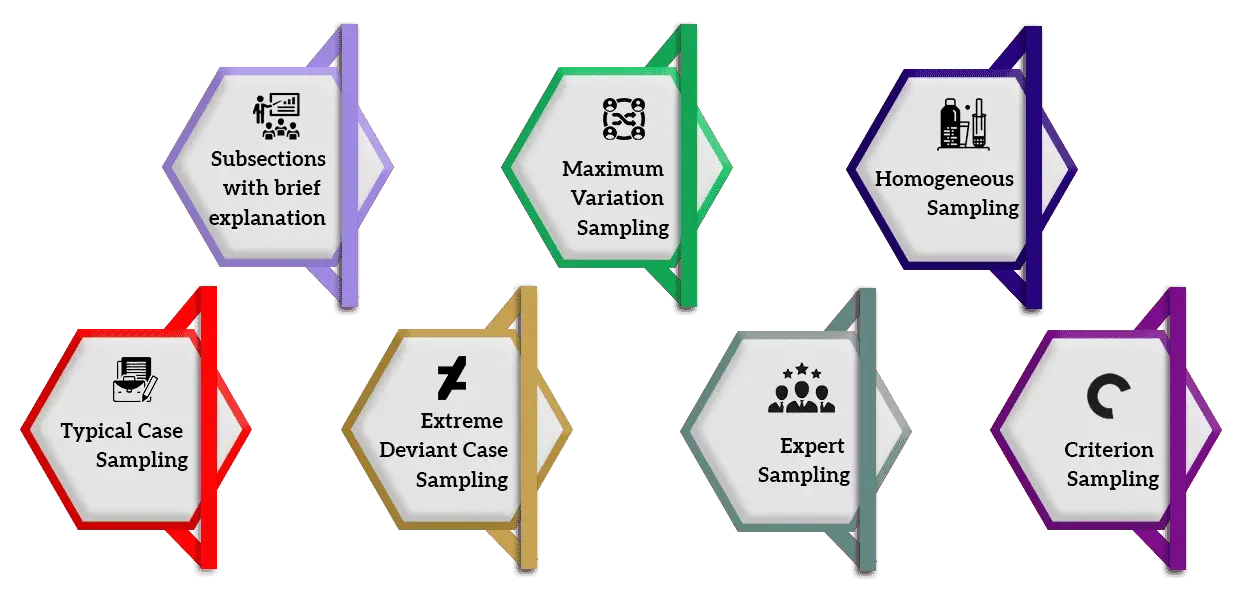
Maximum Variation Sampling
This method aims to gather as many different views as possible that are associated with the case study. By selecting participants or cases with varied characteristics, it emphasizes the common patterns that appear despite the variations. It is similar to casting a wide net to catch the whole range of experiences.
Homogeneous Sampling
This sampling method is the opposite of maximum variation sampling. It aims to gather information from a very specific, similar group in a case study. This method enables researchers to delve deeper into the characteristics, making it easier to analyze the patterns and themes without the interference of too much variation.
Typical Case Sampling
In this method, researchers aim to gather information from the “average” cases in a case study. These cases are not extreme or unusual but rather represent what is common or typical, giving a baseline understanding of the process.
Extreme / Deviant Case Sampling
This type of sampling method aims to gather information from the unusual cases in a case study. By studying these extreme cases, researchers can gain insights and lessons that might not be apparent in the typical cases, giving a new perspective on challenges, successes, or anomalies.
Expert Sampling
This type of sampling is conducted on people who have expertise or experience related to the case study. This is particularly helpful when the complexity of the issue may not be understood by general participants.
Criterion Sampling
In this type of sampling, cases or participants are selected based on predefined criteria that are essential to the case study. This helps the case study have a focused perspective.
Procedural Framework for Implementing Purposive Sampling
When presenting purposive sampling in a research paper format, following a clear procedural framework ensures clarity, precision, and methodological transparency. Our structured approach involves the following steps:
Clarification of Research Objectives
We start by clarifying the research objectives and goals. This helps ensure that all sampling choices are consistent with the research objectives and goals of the study.
Identification of Information-Rich Cases
We then proceed to identify the participants or cases that have the most relevant information, which is best suited to address the research problem.
Establishment of Inclusion/Exclusion Criteria
We establish criteria that help determine which participants or cases to include or exclude, ensuring the sample is relevant and focused.
Justification of Sampling Adequacy
We describe the strategy for participant selection, explaining how each choice is consistent with the research objectives and goals of the study.
Justification of Sampling Adequacy
We justify the size and method of the sample, ensuring that the chosen approach is adequate to meet the research objectives and goals.
Documentation for Methodological Transparency
Finally, we document the entire sampling process in detail, helping the reader understand and assess the methodological accuracy and reliability of the research.
Talk to an Expert
Methodological Considerations in Purposive Sampling
When we apply purposive sampling, it is essential for us to be open and clear about our intentions and methods in selecting participants. Purposive sampling enables us to target people who can give us the most valuable and meaningful information for our research. However, we must also be aware of the limitations of this method and be clear about our rationale in the methodology chapter of our thesis or research paper.
Articulating Purposive Sampling in the Methodology Chapter
In our methodology chapter, we carefully explain purposive sampling, detailing how participants were selected, the rationale behind their inclusion, and how this approach aligns with our research objectives and qualitative design.
Sample Description Structuring
We ensure that we provide a detailed description of the participants' profiles, including their experiences, backgrounds, and the context of the research. We also provide a clear explanation of why each participant was chosen for the study.
Justification Strategies
We highlight the relevance of our participant selection to our research aims and our qualitative approach. Each participant selected has directly contributed to our response to the research questions.
Sample Size Reasoning
We discuss how we determined the number of participants, considering saturation and adequacy, so that our data is deep, reliable, and methodologically sound.
Methodological Strengths
Purposive sampling has many strengths that help make our research more targeted, enlightening, and successful. It enables us to gain access to the most important participants, produce quality data, and explore specialized knowledge efficiently.
-
Access to information-rich cases – We collect valuable information from participants who have the most relevant knowledge or experience related to our study.
-
Depth-oriented data generation – his approach helps us delve deeper into the subject, creating valuable data.
-
Suitability for specialised inquiries – Purposive sampling is most appropriate for specialized research or expert opinions that demand selective participant recruitment.
-
Operational efficiency– It helps us concentrate on data collection, which saves time and resources while ensuring quality research results.
Methodological Limitations and Critiques
Although purposive sampling is very useful, it also has its weaknesses. The researcher’s biases, lack of generalizability, and possibility of selection bias need to be addressed and justified in our research.
-
Researcher subjectivity – We choose who to include, so we have to be careful not to introduce bias.
-
Limited statistical generalizability –The results may not generalize to the population, so we prioritize depth over breadth.
-
Potential selection bias – Selecting participants could introduce bias by excluding viewpoints, so we can explain our thought process to remain transparent.
Start Your Thesis Support
Thesis Writing Assistance for Sampling & Methodology
Many students face serious challenges when designing sampling strategies. Poor justification can weaken an entire thesis, even if the rest of the work is strong.
Common difficulties include:
-
Choosing the appropriate sampling method
-
Explaining the rationale clearly
-
Structuring criteria and sample size arguments
Here’s how our thesis assistance helps:
-
Sampling Design Support: We guide you in building a solid sample that fits your study perfectly.
-
Purposive Sampling Justification: We help explain your participant choices clearly and convincingly.
-
Criteria Structuring: Together, we define exactly who belongs in your study and why.
-
Sample Size Explanation: We ensure your numbers are logical, justified, and defensible.
-
Methodology Writing: With our guidance, sections are crafted to showcase your research skills in the best light.
Getting our expert guidance brings clarity to your methodology and helps elevate the quality of your research.
Conclusion
Purposive sampling is a very effective technique if used judiciously, enabling researchers to obtain in-depth and meaningful data for their research. It is essential to make the right decisions regarding sampling, as it has a direct effect on the validity and reliability of research results.Justification of every decision, whether it is related to the selection of participants or the determination of sample size, is essential to ensure that the research is transparent, well-structured, and methodologically sound.




 By John