Methods of Primary Data Collection in Research Methodology
Data collection is the systematic process of gathering, measuring, and analyzing accurate information from various sources to answer research questions, test hypotheses, and evaluate outcomes. The quality of empirical research depends on the data collection, as it determines the accuracy, reliability, and interpretive force of empirical research.
Researchers are guided by structured procedures that help them collect evidence to support the theoretical claims and analytical reasoning. Inefficient data collection leads to bias, weakness in validity, and invalidity of conclusions. Data related to primary data is particularly important, as one can gain fresh information through the concerned sources.
The methods of primary data collection in research methodology are the main focus of academic activity, particularly when examining the Major Methods of Primary Data Collection, which are used to generate valid, reliable, and study-specific evidence.
Contact us
Concept of Primary Data
Primary data are raw facts gathered by a researcher to answer a given research objective. The data are not obtained by extracting them from existing materials, but they are the result of direct interaction with the participants, environment, or experimental conditions.
Primary data consist of first-hand information having a specific purpose, context, and closely related to the research goals, unlike secondary data, which are pre-existing, already analyzed, and interpreted information. In a data analysis research paper, primary data are “raw data" obtained through surveys, interviews, experiments, or observations, ensuring high relevance and accuracy.
Fundamental Characteristics of Primary Data
Rooted in the initial research problem idea, primary data possesses several defining attributes essential to research design and methodological rigour:
-
Direct Acquisition
Primary data are gathered directly by the researcher, which increases the authenticity and minimizes errors in interpretation.
-
Study-Specific Relevance
The information is customized to a specific research issue, with conceptual correspondence to the study.
-
More Control on Data Quality.
The instruments and sampling, as well as measurement procedures, are designed by researchers.
-
Contextual Precision
The information indicates real-time circumstances, peculiar to the investigation environment.
-
Resource-Intensive Nature
Primary data is costly to collect in terms of time, planning, and finances.
Significance of Primary Data in Scholarly Research
Primary data enhances validity, reliability, and originality in research. They are particularly important in dissertations, doctoral studies, fieldwork, and experiments. Primary data allow testing of hypotheses and measurement of variables to introduce new empirical knowledge by extending the available datasets. They also strengthen internal validity as they provide evidence that directly correlates with research goals and a detailed understanding of behavioural, social, and scientific phenomena.
Get a Free Consultation Today
Core Methods of Primary Data Collection in Research
The technique selected must align with the objectives, analysis requirements, and the research design in the research methodology.
Interviews
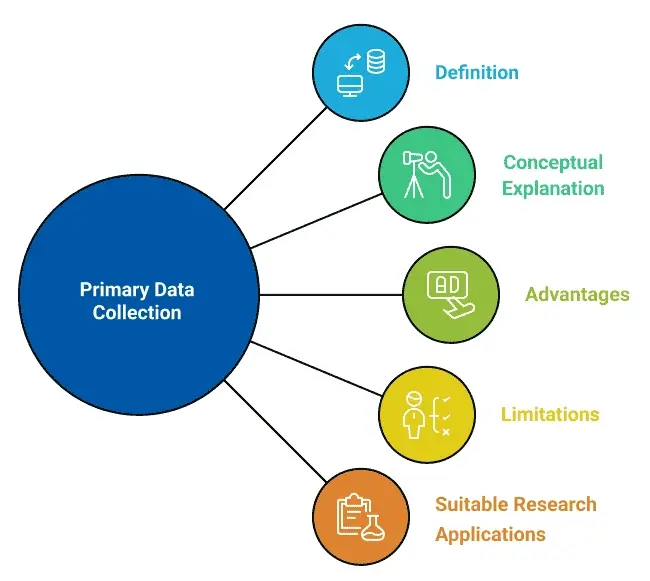
Definition
One of the most frequently used primary data collection techniques is interviews, which is a systematic verbal communication between a researcher and a respondent. This aims to get detailed information.
Conceptual Explanation
The approach examines subjective experiences, perceptions, attitudes, and interpretations. Questions may be designed to be structured, semi-structured, or unstructured. Interviews are useful to get subtle qualitative information that is not readily available using standardized tools.
Advantages
-
Generates rich, detailed data
-
Enables probing and clarification
-
Suitable for complex research questions
Limitations
Suitable Research Applications
-
Studies requiring in-depth qualitative insights
-
Exploratory and interpretive research designs
-
Investigations of experiences, perceptions, and motivations
-
Research involving complex or sensitive topics
-
Small, targeted participant groups
Surveys
Definition
A structured way of primary data collection is through surveys. They apply standardized tools to collect data about a specified population.
Conceptual Explanation
Surveys are quantitative measures of variables. They allow researchers to quantify patterns, relationship and trends on large sample sizes. This helps them get perfect data creation that can be statistically analyzed.
Advantages
-
Broad population coverage
-
Statistical analysis compatibility
-
Efficient for large samples
Limitations
Suitable Research Applications
-
Large-scale population studies
-
Quantitative research designs
-
Studies emphasizing generalizability
-
Measurement of trends, patterns, and relationships
-
Cross-sectional and longitudinal investigations
Questionnaires
Definition
Questionnaires are official research tools. They are well-organized questions to prompt the participants' responses.
Conceptual Explanation
The theoretical constructs are operationalized into measurable indicators using questionnaires. This enables the same data to be collected amongst the respondents. The items may be closed-ended, open-ended, or scaled, as per the purpose of analysis.
Advantages
Limitations
Suitable Research Applications
-
Standardized data collection contexts
-
Large or geographically dispersed samples
-
Quantitative variable measurement
-
Attitude, perception, and behaviour studies
-
Research requiring efficiency and scalability
Observation
Definition
Observation defines the systematic observation and documentation of behaviors, events, or phenomena in natural or controlled conditions.
Conceptual Explanation
This method emphasizes direct evidence acquisition without reliance on participant self-reporting. Observation enables researchers to examine actual behaviors, interactions, and environmental conditions, enhancing ecological validity.
Advantages
Limitations
-
Observer error risk
-
Ethical considerations
-
Limited variable control
Suitable Research Applications
-
Behavioural and interaction studies
-
Naturalistic research settings
-
Studies minimizing self-report limitations
-
Ethnographic and field-based investigations
-
Context-dependent phenomenon analysis
Experiments
Definition
Primary data collection techniques involve experiments where manipulation of independent variables is done to test their impact on the dependent variables.
Conceptual Explanation
Experimental designs are based on causal inference. They allowed researchers to establish controlled conditions to test theoretical associations, with the highest internal validity achieved by systematically controlling the variables.
Advantages
-
Strong causal inference
-
High internal validity
-
Precise variable control
Limitations
Suitable Research Applications
-
Causal inference studies
-
Hypothesis-testing research designs
-
Variable manipulation investigations
-
Controlled research environments
-
Studies examining cause–and–effect relationships
Focus Groups
Definition
Focus groups refer to discussions in groups guided by a moderator to obtain qualitative information from several individuals at the same time.
Conceptual Explanation
The approach is based on the communicative dialogue. Interactions between the participants lead to the development of collective views, meanings, and attitudinal dynamics. The group interaction will unveil further information that a single data collection won't do.
Advantages
Limitations
-
Group influence twist
-
Limited generalizability
-
Moderation sensitivity
Suitable Research Applications
-
Exploratory qualitative research
-
Attitude and perception studies
-
Research examining group dynamics
-
Market, social, and behavioural investigations
-
Idea generation and concept testing
Case Studies
Definition
The case study is a rigorous primary data collection method, which is aimed at in-depth analysis of a particular object, entity, or phenomenon.
Conceptual Explanation
The case study approach gives importance to contextual richness. It focuses on the overall study of complex systems, processes, or events. The strategy allows the development based on in-depth, situation-based evidence in theory.
Advantages
-
Detailed contextual understanding
-
Suitable for complex systems
-
Theory development potential
Limitations
-
Limited generalization
-
Time-intensive
-
Potential subjectivity
Suitable Research Applications
-
In-depth contextual investigations
-
Complex phenomenon analysis
-
Organizational, clinical, or social research
-
Studies prioritizing depth over generalization
-
Theory-building research contexts
Pilot Studies
Definition
Pilot studies are mini studies carried out before the implementation of large-scale research.
Conceptual Explanation
Methodological validation mechanisms are pilot studies. They determine the reliability of instruments, conducting the process, the sufficiency of sampling, and error sources. This minimizes the risk in the latter stages of research.
Advantages
-
Reduces methodological errors
-
Improves instrument reliability
-
Enhances study design precision
Limitations
Suitable Research Applications
-
Instrument testing and refinement
-
Methodological feasibility assessment
-
Error identification and reduction
-
Research design validation
-
Pre-study procedural evaluation
Comparative Evaluation of Primary Data Collection Methods
| Method |
Type of Data |
Main Advantage |
Main Limitation |
Best Used When |
| Interviews |
Detailed opinions&explanations |
Provides deep insights |
Time-consuming&resource-intensive |
An in-depth understanding is required |
| Surveys |
Numerical&opinion-based data |
Covers large populations efficiently |
Risk of low or inaccurate responses |
Studying trends, patterns, or relationships |
| Questionnaires |
Structured measurable responses |
Ensures consistency&standardization |
Quality depends on question design |
Measuring attitudes, perceptions, behaviours |
| Observation |
Actual behaviours& interactions |
Captures real-world actions |
Limited control over variables |
Studying trends, patterns, or relationships |
| Experiments |
Measured numerical outcomes |
Establishes cause and effect relationships |
Complex & operationally demanding |
Testing hypotheses & causal relationships |
| Focus Groups |
Group opinions&discussions |
Reveals multiple perspectives quickly |
Responses influenced by group dynamics |
Exploring perceptions, reactions, and ideas |
| Case Studies |
Context-rich qualitative/mixed data |
Offers deep contextual understanding |
Limited generalisation |
Analysing complex or unique cases |
| Pilot Studies |
Preliminary test data |
Identifies design&instrument issues |
Not suitable as standalone research |
Validating research design&tools |
Methodological and Ethical Considerations in Primary Data Collection
The selection of a primary data collection method is a critical process in determining the quality of research. The selection should align with research objectives, prioritizing depth, breadth, or causal relationships.
The appropriateness of study design is determined by suitability, whereas feasibility and representativeness depend on the characteristics of the sample. Operational boundaries are established by practical limitations on budget and time, and ethical considerations define permissible data collection approaches.
Sources of Error in Primary Data Collection
Primary data collection is inherently susceptible to methodological errors that may compromise research integrity.
Sampling Error
In sampling error, the participants selected are not representative of the population. This constrains external validity and findings.
Measurement Errors
Measurement error is either due to poorly constructed instruments, ambiguous items, or inconsistent procedures. They decrease reliability and place a risk to construct validity.
Response Distortion
Distortion of responses occurs when respondents provide incorrect, partial, or erroneous responses. This compromises the validity and accuracy of data.
Observer Effect
Observer effect is a situation that occurs when a researcher's expectations affect data recording. It risks objectivity and brings about systematic distortion. Collectively, these errors disrupt empirical relationships, weaken validity, and reduce reliability.
Invalid measurements compromise the accuracy of conclusions, while unreliable procedures undermine the dependability and reproducibility of findings.
Ethical Framework in Primary Data Collection
Ethical integrity constitutes a foundational requirement in primary research involving human participants.
Informed Consent
Participants must be provided with clear and comprehensive information regarding research objectives, procedures, risks, and rights to ensure voluntary participation.
Confidentiality
Confidentiality ensures the privacy of the participants’ information by restricting unauthorized disclosure and protecting sensitive data.
Anonymity
Anonymity ensures that participant identities remain untraceable, thereby reducing potential risks and response distortions.
Institutional Approvals
It is required that Ethics Committees or Institutional Review Boards grant formal approval of compliance with ethical principles and academic regulations.
By following the ethical principles, the participants are safeguarded, and the research’s credibility, validity, and scholarly acceptability are enhanced.
Our Research Methodology Experts Support Your Study Design
We offer research methodology support. Our advice would enable researchers to create valid and justifiable research designs. We match study design and sampling strategy, data collection method, and data analysis. We assist researchers to increase their validity, reliability, and academic integrity by ensuring the precision of the methods used.
By strengthening methodological precision, we help researchers enhance validity, improve reliability, and reinforce scholarly credibility.
Support Areas
We provide research methodology support in:
-
Research design selection
-
Primary data collection planning
-
Sampling techniques and justification
-
Questionnaire and interview design
-
Hypothesis and variable structuring
-
Data analysis strategy
-
Methodology chapter development
Benefits for Researchers
Our research methodology supports:
-
Reduction of methodological errors
-
Strengthening of research validity and reliability
-
Enhanced conceptual and analytical clarity
-
Improved academic defensibility
-
Greater approval and publication potential
-
Increased methodological confidence
Through systematic guidance, we assist scholars in aligning methodological decisions with research objectives, theoretical frameworks, and analytical requirements. Researchers seeking structured methodological support may benefit from expert assistance in strengthening the rigor, coherence, and academic defensibility of their research design.
Conclusion
Empirical research is largely based on primary data as it provides novelty, context, and accuracy. The methods of primary data collection in research methodology offer researchers a variety of instruments to produce valid and trustworthy evidence.The selection of methods, the organisation of errors, and the high level of adherence to ethical standards all contribute to the quality of the research. The profound knowledge of the Major Methods of Primary Data Collection is vital to academic research and analytically effective studies. still vital to the research of academic and analytically effective studies.



 By John