Sentiment Analysis Research Papers: A Step-by-Step Research and Publication Guide
Sentiment analysis research papers play an indispensable role in natural language processing, enabling researchers to systematically investigate opinions, emotions, and attitudes expressed in text. Contrasting with tutorials, blogs, or commercial sentiment analysis tools that usually focus on practical applications or surface insights, academic research papers place strong emphasis on novel contributions, methodological rigor, and reproducibility of results.
This tutorial is designed to walk researchers through the step-by-step process of creating high-quality research in sentiment analysis. Types of research approaches, methodological strategies, dataset selection and preprocessing, evaluation metrics, common challenges in the field, and practical guidance on how to publish will be discussed in this work.
This structured approach will guarantee your research is academically worthy and in tandem with the latest trends and journal expectations. Before starting any study, it is essential to clarify the research goal and expected contribution in the first paragraph of your paper. This clarity sets the stage for methodological decisions, demonstrates the significance of your work, and positions your study clearly within the academic landscape.
contact us
What Are the Goals of Sentiment Analysis Research Papers?
While writing a data analysis-based research paper concerning the task of sentiment analysis, the very first step is to clearly define the objective of the research. It can be said that the overall objective of the research sets the tone, as the entire basis of the research revolves around that, and the approach can be determined by it. Being clear about your contribution can result in the guarantee of accepting the manuscript into the journal.
Typically, the objective of a research paper on sentiment analysis is to:
-
Develop new methods or algorithms: Innovate techniques for detecting sentiment more accurately, handling sarcasm, or processing multilingual text.
-
Contribute or annotate datasets: Build or enhance high-quality datasets that researchers can use for training and evaluation.
-
Apply sentiment analysis to specific domains: Adapt models to areas like healthcare, finance, social media, or political discourse, each with unique challenges.
-
Compare models or approaches: Benchmark new methods against existing ones to highlight improvements or limitations.
The key here is research quality and originality. Clearly defining your contribution ensures your methodology aligns with your objectives, demonstrates the relevance of your work, and positions your paper as a meaningful addition to the field. Laying this foundation early makes the rest of your research smoother and more credible.
How Has Sentiment Analysis Evolved in Academic Research?
Sentiment analysis has grown dramatically over the past two decades. Scholars have shifted from using scoring systems to relying on sophisticated models involving deep learning and transformers. The following are step-by-step explanations of the evolutionary process.
Lexicon-Based Approaches
Earlier sentiment analysis techniques were based on word scoring with tools such as SentiWordNet. They assign sentiment scores to words based on their meaning and aggregate the scores to evaluate the sentiment of text.
Advantages:
-
Very simple to implement
-
Low computational cost
Limitations:
-
Cannot fully understand the context
-
Struggles with sarcasm, idioms, or complex expressions
While lexicon-based approaches laid the groundwork, their inability to handle nuance led researchers to explore machine learning methods.
Machine Learning Approaches
Supervised machine learning models such as SVM, Naive Bayes, and Random Forest brought a major leap forward. These models use features like TF-IDF vectors and N-grams to learn patterns in text.
Why they improved performance:
-
More exact than lexicon-based approaches
-
Can generalize better across datasets
-
Capture some contextual information, though still limited
The machine learning approaches then became a standard for many years, providing a more robust and scalable framework for sentiment prediction.
Deep Learning Approaches
The deep learning era introduced sequence-based models like CNNs, LSTMs, and GRUs. These architectures capture contextual meaning across sequences of words, rather than treating words independently.
Considerations:
-
Require large amounts of labeled data
-
Harder to interpret, explaining predictions can be challenging
-
Improved performance for nuanced sentiment detection
Deep learning models set new performance benchmarks but came with higher computational costs and interpretability challenges.
Transformer-Based Models and LLMs
Currently, the latest breakthroughs in sentiment analysis are based on pre-trained transformer models, including BERT, RoBERTa, and GPT models.
Advantages
-
Handle long-range dependencies and context effectively
-
Accurately capturing nuanced sentiment, sarcasm, and complex language patterns
Considerations
-
Fine-tuning requires careful dataset preparation
-
High computational resources
-
Evaluation metrics must be chosen thoughtfully to reflect real-world performance
Timeline of Evolution:
-
2000s – Lexicon-Based: Small datasets, dictionary-driven scoring
-
2010s – Machine Learning: Medium datasets, feature-based supervised models
-
Mid-2010s – Deep Learning: Large datasets, sequence-based models like LSTM/CNN
-
2020s – Transformers & LLMs: Massive datasets, pre-trained contextual models
This evolution highlights the shift from simple, rule-based methods to complex, context-aware models, reflecting the growing sophistication of datasets, evaluation standards, and research objectives in sentiment analysis.
Which Types of Sentiment Analysis Are Common in Research?
When exploring sentiment analysis, researchers often focus on different types depending on their research gap and objectives. Choosing the right type ensures your methodology aligns with your study’s goals. Here’s a breakdown of the most common types:
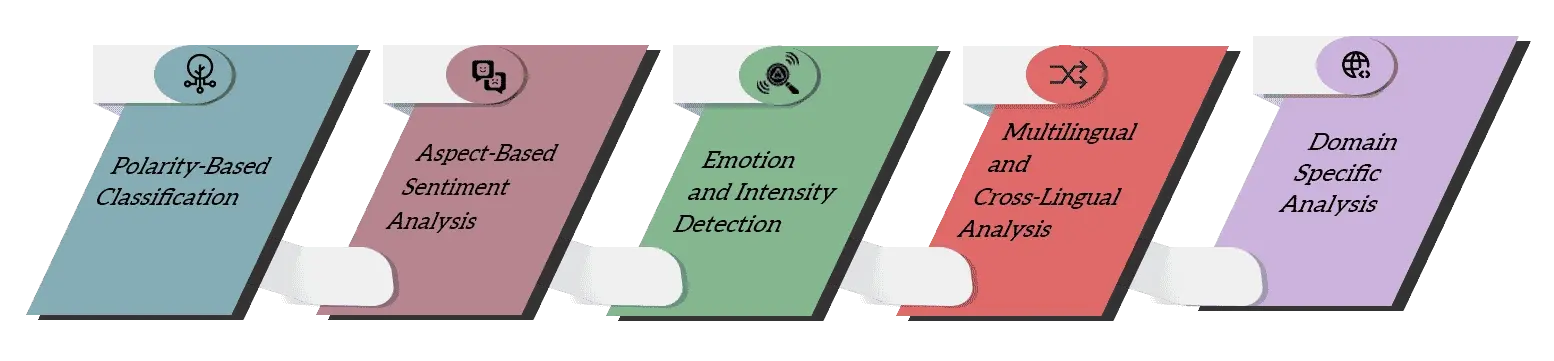
Polarity-Based Classification
-
This is the simplest method; here, text can be classified as positive, negative, or neutral. It is best suited when research is to be conducted to understand overall trends in sentiments.
-
Choose datasets that are well-annotated for polarity, like IMDb reviews or Twitter sentiment datasets. Standard classifiers, such as SVM, Naive Bayes, or logistic regression, often provide solid baselines.
-
Polarity classification serves as a groundwork for comparison with new models or when a more detailed analysis is necessary.
Aspect-Based Sentiment Analysis (ABSA).
ABSA goes beyond overall sentiment and focuses on specific entities or aspects in the text. For example, in product reviews, a user may praise battery life but criticize camera quality.
-
Dataset Preparation: Label datasets with aspects, use categories to create outputs for entity-level sentiment.
-
Applications: It can offer detailed information to businesses or research that demands analysis of particular features.
-
Research Gap Alignment: The main gap in fine-grained sentiment modeling identified by ABSA is addressed in this research.
Emotion and Intensity Detection
This approach captures multiple emotions (e.g., joy, anger, sadness) and measures their intensity, providing deeper insights than simple positive/negative classifications.
-
Dataset Requirements: Include multi-class datasets with emotion labels and intensity scores.
-
Applications: Useful for social media analysis, surveys, and customer feedback, allowing researchers to capture subtle emotional nuances.
-
Research Gap Alignment: Detecting complex emotions remains a challenge, offering opportunities to improve models or scoring techniques.
Multilingual and Cross-Lingual Analysis
This type has the ability to adapt the sentiment analysis techniques for use in multiple languages in order to fulfill the needs in global research areas
Methods: Multilingual embeddings or translation pipelines.
Documentation: Properly document strategies for adapting datasets and models.
Research Gap Alignment: The models do not perform uniformly well across all languages, giving room for improvement.
Domain-Specific Analysis
Domain-specific approaches tailor sentiment models for areas like healthcare, finance, or social media.
-
Dataset Selection: Use datasets relevant to the domain and validate model performance carefully.
-
Applications: Ensures insights are accurate and actionable within specialized contexts.
-
Research Gap Alignment: Domain adaptation and generalization remain open challenges in sentiment analysis.
By carefully choosing the type of analysis that aligns with your research gap, you can design a study that is methodologically sound, practically relevant, and positioned for meaningful contributions to the field.
Research Methodologies Used in Sentiment Analysis Papers
Sentiment analysis research employs a variety of methodologies, each suited to different datasets, objectives, and research gaps.
Lexicon
The initial steps involve using the appropriate lexicons and handling negations to calculate the sentiment score. The results are compared with basic techniques, and care is taken to mention limitations like poor context handling and lack of robust sarcasm detection, among others.
Machine Learning-Based Methods
Second, extract features like TF-IDF or N-gram, and then train classifiers like SVM, Naive Bayes, or Random Forest. Hyperparameters should be tuned extensively, and the performance should be evaluated via cross-validation, as well as reporting the performance based on standard measures.
Deep Learning Techniques
Compute the text data embedding, then build sequence models, such as models based on CNN, LSTM, or GRU. Test the model, explaining the difficulties in terms of interpretability, while comparing the results with those achieved using ML.
Transformer Models
Fine-tune pre-trained models such as BERT or RoBERTa for sentiment-specific tasks. Adapt to your datasets, evaluate rigorously, and ensure novelty by comparing with prior deep learning and transformer research.
Hybrid/Ensemble Models
Combine approaches, such as lexicon + ML or ML + DL, to enhance performance. Provide baseline comparisons and justify the hybrid approach academically. Select the methodology based on dataset size, novelty, and journal expectations to maximize research impact.These methodologies provide a structured framework for conducting robust, reproducible, and high-impact sentiment analysis research.
Dataset Selection and Preprocessing
Choosing and preparing the right dataset is a crucial step in sentiment analysis research. Proper preprocessing ensures clean input for models and reliable, reproducible results.
Dataset Choice: High-quality datasets like IMDb, Twitter, or SemEval.
Preprocessing Steps:
Ethical Considerations: Check dataset licensing and ensure responsible usage.
Reproducibility: Document preprocessing steps clearly for transparency and replication.
Experimental Design and Evaluation
A research design is important in ensuring that effective results are realized in sentiment analysis. By ensuring accurate performance, and that improvements over previous approaches can be measured.
-
Data Splitting: Divide datasets into training and testing sets to validate model performance.
-
Cross-Validation: Use cross-validation to enhance robustness and reduce overfitting.
-
Evaluation Metrics: Assess models using Accuracy, Precision, Recall, and F1-score.
-
Baseline Comparison: Always compare results with baseline models to measure improvements.
-
Statistical Significance: Report significance tests to ensure results are meaningful.
-
Reproducibility: Document experimental setup and results clearly for replication by other researchers
Key Challenges Highlighted in Sentiment Analysis Research
Sentiment analysis research comes with several challenges that need careful attention to produce meaningful results.
-
Sarcasm and Context Ambiguity: Identify and mitigate sarcastic or ambiguous expressions in datasets to improve model accuracy.
-
Domain Shift and Dataset Bias: Evaluate cross-domain performance to ensure models generalize beyond their training data.
-
Model Explainability: Incorporate attention visualizations or interpretability techniques to make predictions transparent.
-
Scalability and Computation: Report model efficiency and computational limitations, especially for large datasets.
-
Ethics and Privacy: Ensure data anonymization, consent, and ethical usage are documented throughout research.
Applications of Sentiment Analysis in Academic Research
The impact of research is enhanced by linking it with its practical applications in the real world
-
Social Media/Opinion Mining: Ensure alignment with the aim of obtaining significant trends from user-generated content.
-
Business/Brand Perception: Modify models to suit customer feedback analysis and brand perception.
-
Political/Public Opinion: Build time-sensitive data sets to gauge public feelings about a political issue or an election.
-
Healthcare/Patient Feedback: Anonymise Patient Information and Derive Insights for Healthcare Improvements.
-
Emerging Interdisciplinary Applications: Establish novelty and research contributions to new domains.
Literature Review Trends and Research Gaps
A critical literature review will help the researcher find the trends, gaps, and opportunities for improvement concerning sentiment analysis. It guides the formulation of meaningful research questions and positions your study for originality.
Systematic Trend Extraction: Go through the recent review papers to trace the dataset, model, and methodology usage.
Overresearched Topics: Emphasize those areas in which much research has already been carried out to avoid duplications.
Under-researched areas: The identification of under-researched gaps that allow proposals for innovative contributions has immense on-site value.
Formulate Research Questions: Based on the identified gaps, design questions that directly address them.
Stepwise Approach: Clearly justify how your study contributes novel methods, insights, or applications.
Expert Support for Publishing High-Impact Sentiment Analysis Papers
Even strong research benefits from our expert research assistance to ensure clarity, proper formatting, and a polished, publication-ready manuscript.
Our expert support helps authors by:
-
Strengthen Novelty & Methodology: Take your research to the next level with robust methodological design, innovative approaches, and proper differentiation from existing research.
-
Refine Results & Clarity: Transform complex findings into insightful, well-articulated conclusions that resonate with reviewers and readers.
-
Journal Compliance & Pre-Submission Checks: Focus on immaculate presentation, conformity, and robust pre-submission checks to achieve maximum acceptance probability.
-
Researcher-Led, Ethical Support: Preserving full ownership of your work, with support based on ethical guidelines such as honesty, transparency, and excellence.
With our professional assistance, authors can save time, reduce revision stress, and greatly improve their chances of acceptance into academic programs.
Conclusion
High-impact research in sentiment analysis is based on precision and methodological novelty. This structured approach, from literature review to experimental design, guarantees that your work is reproducible, meaningful, and academically valuable.
The field keeps growing at a fast pace, with a constant stream of opportunities for innovative approaches, interdisciplinary uses, and new methodologies. Through careful planning, ethical practices, and clear reporting, researchers will be able to present studies that advance not only the academic but also the real-world applications of sentiment analysis.




 By John