Problem Identification in Marketing Research: Methodologies, Sources, and Analytical Approaches
In competitive markets, Problem Identification in Marketing Research is the difference between insight-driven growth and costly guesswork. When the problem is defined wrongly, organisations burn research dollars, draw wrong conclusions, and run campaigns that are off-target.
Even strong data and sophisticated analytics cannot make up for a wrong foundation. Proper problem identification helps ensure that marketing research is aligned with business strategy, targets the root causes of performance, and enables informed decision-making.
This blog will help marketers understand the strategic value of identifying the right problem, the sources that shape it, and the methods that can break down tough business problems into meaningful research directions.
How Problem Identification Shapes the Success of Marketing Research
Problem identification influences the entire process of marketing research. If the problem is identified properly, it becomes easy to select the proper research design, research methods, data, and analysis techniques. Each step, from planning to implementation, remains focused on answering a single business question.
This applies to corporate research as well as an MBA Dissertation, where a properly identified problem results in valuable analysis rather than generic conclusions. In the corporate world, proper problem identification results in better targeting of customers, higher ROI, and findings that can be used by managers for decision-making.
It also helps distinguish between strategic research (such as brand positioning or market entry) and tactical research (such as campaign evaluation or pricing research). When the problem is properly identified, research remains focused on business objectives and results in actionable outcomes.
Translating Business Challenges into Researchable Problems
Business challenges often appear as broad symptoms rather than clearly defined issues. Declining sales, rising customer churn, low campaign engagement, or market misalignment are signals that something is wrong, but they are not research problems by themselves.Problem Identification in Marketing Research plays a crucial role in getting behind these symptoms to uncover the underlying issues that can actually be researched and solved.
This is no different from how dissertation topics for MBA finance are developed from general business concerns into specific, researchable questions.
Steps to Convert Business Challenges into Researchable Problems
-
Identify the symptom: Clearly state what is happening (e.g., declining sales in a specific segment).
-
Analyse the context: Determine when, where, and among which customers the issue occurs.
-
Question assumptions: Avoid jumping to conclusions, such as pricing or promotion being the cause.
-
Isolate the root cause: Examine factors like customer perception, value mismatch, or competitive pressure.
-
Frame the research problem: Convert the root cause into a clear, measurable research question.
Key Information Sources Driving Accurate Problem Identification
Accurate problem identification relies on multiple information sources. Each perspective uncovers hidden causes beyond symptoms, ensuring the Problem Identification in Marketing Research is precise, actionable, and aligned with business objectives.
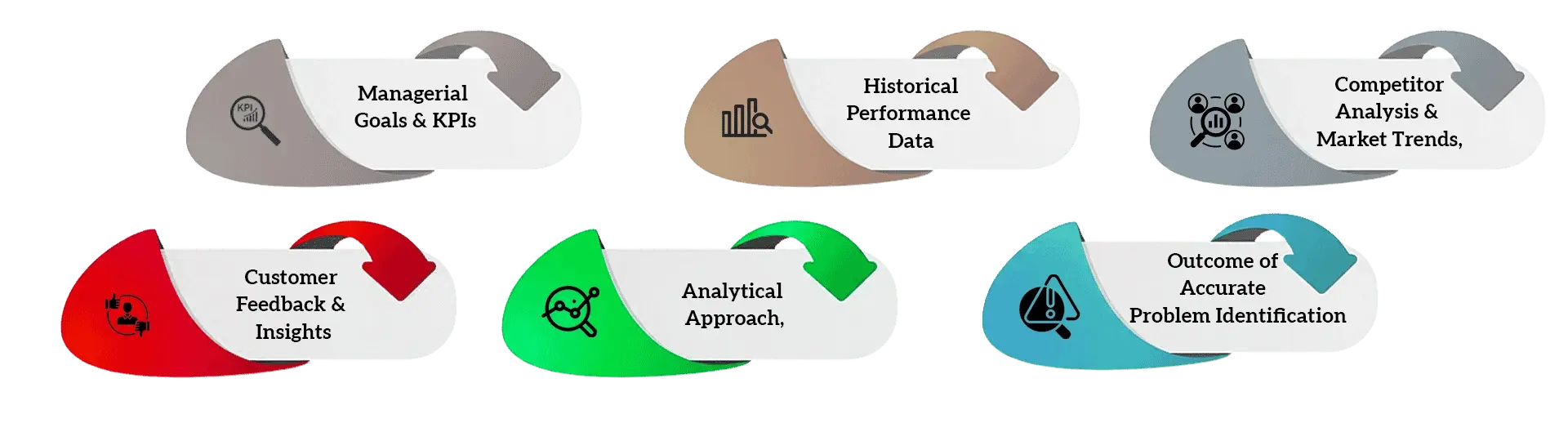
Managerial Goals & KPIs
Goals and KPIs determine success. By aligning research with goals such as revenue, engagement, and retention, researchers can be assured that findings meet key business needs.
Historical Performance Data
Historical sales, campaigns, and customer data analysis helps identify trends. It separates short-term problems from long-term issues, pointing researchers to areas that require exploration.
Competitor Analysis & Market Trends
Competitor analysis and market trends analysis helps identify external factors. It helps ensure that research is not mistakenly focused on internal business problems that are actually being driven by external factors.
Customer Feedback & Behaviour
Customer surveys, reviews, and online behaviour provide feedback on unmet needs or frustrations.
Example Scenario:
A retail brand noticed declining online sales. By combining multiple sources:
-
KPIs highlighted a drop in revenue
-
Historical data showed high cart abandonment rates
-
Competitor analysis revealed aggressive pricing strategies by rivals
-
Customer feedback pointed to a confusing checkout process
The real problem was identified as checkout friction for mid-tier customers, not simply “low sales.” Addressing this specific issue led to optimized checkout flows and a significant increase in conversions.
Tools and Techniques for Problem Identification in Marketing Research
To better understand marketing problems, researchers employ a variety of specific tools:
-
Situation Analysis (SWOT, PESTEL, Market Scans): Offers a strategic perspective on internal and external factors.
-
Exploratory Research (Focus Groups, Pilot Studies): Reveals perceptions, attitudes, and possible hypotheses.
-
Conceptual Models & Frameworks: Organizes thinking, locates gaps, and suggests possible causal links.
-
Surveys, Interviews, Observations: Obtains quantitative and qualitative data to test assumptions.
Advantages & Limitations
-
SWOT/PESTEL: Macro-focused, may overlook micro-problems
-
Focus Groups: In-depth information, but not generalizable
-
Surveys: Quantifiable, scalable, but vulnerable to design bias
By employing these tools in combination, a 360° perspective on the problem is achieved.
Business Impact of Effective Problem Identification in Marketing Research
Proper problem identification has a direct and measurable impact on business outcomes. When marketers define the real issue clearly, research becomes focused, insights are actionable, and decisions are strategic.
Better Marketing Strategy and Decisions: By identifying the right problems, marketing efforts are directed at the correct audience, messages are aligned with customer needs, and strategies are developed for long-term growth.
Efficient Use of Research Budget: The budget is allocated to the right areas of research, and there is no wastage of budget on irrelevant research.
Higher ROI on Campaigns: Research indicates that companies with clearly articulated research problems have a higher ROI on their marketing campaigns because the findings of the research are used to take effective actions.
From Problem Identification to Actionable Research Objectives
The shift from problem identification to research objectives is a strategic move. A well-articulated problem statement is the foundation for establishing measurable research objectives that are in sync with the organizational strategy.
Checklist for deriving actionable research objectives:
-
Define the problem clearly
-
Identify key variables affecting the issue
-
Determine measurable outcomes
-
Align objectives with broader strategic goals
How Expert Support Enhances Problem Identification in Marketing Research
Marketing problems with multiple variables require expert problem identification.
Research assistance in problem identification in marketing research. Our Expert support ensures that problem identification is accurate and efficient. Expert support ensures that problem identification is accurate and efficient.
Why Expert Support is Important:
-
Experts help in formulating a framework to identify the problem.
-
Experts help in identifying the variables and ensuring that the outcome is measurable.
-
Expert support helps in improving research design, data, and analysis.
-
Multi-variable problems require expert support, which saves time and money.
Conclusion
Problem Identification in Marketing Research is the foundation for effective marketing planning. Effective problem identification provides:
By applying structured methodologies, integrating diverse sources of information, and accessing our expert research problem identification assistance, organizations can guarantee that research is accurate, effective, and focused on organizational goals. Effective problem identification helps to shift marketing research from a cost center to a strategic driver.



 By Emilia