What Is Impact Factor? A Structured Evaluation of Journal Metrics
What is the impact factor? It is a citation metric that can be used to estimate article citation frequencies within a specified time window, which is used to calculate the impact factor for that particular journal. There was an initial intention for it not to be used for article or researcher evaluation, but rather for facilitating comparisons between journals for journal indexing. However, it still has applications that deviate from its intended purpose in making certain academic judgments, for instance, regarding journal selection.
This article presents an analytical examination of the impact factor with attention to:
-
Its calculation research methodology
-
Journal-level citation distribution patterns
-
Structural and methodological limitations
-
The role of complementary journal metrics
What Is the Impact Factor of a Journal?
The impact factor of a journal is a citation-based metric that indicates the average number of citations each citable item in a journal receives over a defined period. It represents citation frequency, rather than research quality, originality, or scholarly merit. Impact factor is strictly a journal-level indicator and should never be applied to evaluate individual articles, authors, or institutions, as citation patterns within journals are uneven.
Citation accumulation varies by discipline. Life sciences and medicine generally show rapid citation growth, whereas humanities and social sciences accumulate citations more slowly. As a result, impact factor values are meaningful only when interpreted within the same field.
How Journal Impact Factor Is Calculated
Journal impact factor (IF) is calculated using a standard two-year citation window, which captures recent citation activity rather than long-term influence. The formula is:
Citations in 2024 to articles published in 2022 and 2023
Impact Factor (2024) = ______________________________________________________
Number of citable items published in 2022 and 2023
Explanation:
-
Numerator: Counts all citations in 2024 to research articles and review papers published in 2022 and 2023.
-
Denominator: Includes only citable items (research articles and reviews) published in 2022 and 2023.
Example:
If a journal published 120 citable items in 2022–2023 and those items received 360 citations in 2024:
IF (2024)=360÷120=3.0\text{IF (2024)} = 360 ÷ 120 = 3.0IF (2024)=360÷120=3.0
This calculation shows the short-term nature of the two-year window, reflecting recent citation trends rather than long-term influence.
Detailed Journal Impact Factor Distribution (2024 JCR Data)
The table below provides an evidence-based overview of journal impact factors, with the source material being the 2024 Journal Citation Reports (JCR). For each range of impact factor values, it gives the number of journals falling into that range, together with the percentage of the total journal population. This distribution is intended for analytical interpretation and not as a ranking of journals.
|
Impact Factor Range
|
Number of Journals
|
% of Total Journals
|
|
25+
|
80
|
0.36%
|
|
20 – 24.9
|
150
|
0.68%
|
|
15 – 19.9
|
320
|
1.44%
|
|
12 – 14.9
|
450
|
2.03%
|
|
10 – 11.9
|
560
|
2.52%
|
|
9 – 9.9
|
630
|
2.83%
|
|
8 – 8.9
|
780
|
3.51%
|
|
7 – 7.9
|
1,020
|
4.59%
|
|
6 – 6.9
|
1,350
|
6.08%
|
|
5 – 5.9
|
1,890
|
8.51%
|
|
4 – 4.9
|
2,900
|
13.06%
|
|
3 – 3.9
|
4,800
|
21.64%
|
|
2 – 2.9
|
8,300
|
37.44%
|
|
1 – 1.9
|
13,600
|
61.3%
|
|
0 – 0.9
|
21,900
|
100%
|
Analytical Interpretation:
Journals with an impact factor above 20 are very rare, making up less than 1% of all journals. Most journals have an IF below 2, which is statistically normal. Moderate ranges (IF 2–10) cover a large portion of journals, showing that most publications receive typical citation counts.
Impact factor patterns differ by discipline. Life sciences and medicine tend to have higher citation densities, while humanities and social sciences accumulate citations more slowly. This highlights that IF should always be interpreted within the context of the same field, not compared across disciplines.
Interpreting Impact Factor Correctly
Researchers should consider the impact factor (IF) within its proper context, not as an independent measure. High IF does not automatically mean higher research quality, and low IF does not indicate low scientific value. Meaningful evaluation is possible only within the same disciplinary field, as citation practices vary significantly across areas. Comparing journals across unrelated disciplines can be misleading and should be avoided.
Complementary Journal Metrics Beyond Impact Factor
A citation impact factor alone cannot convey a complete picture of publication influence. It should be complemented with other indicators.
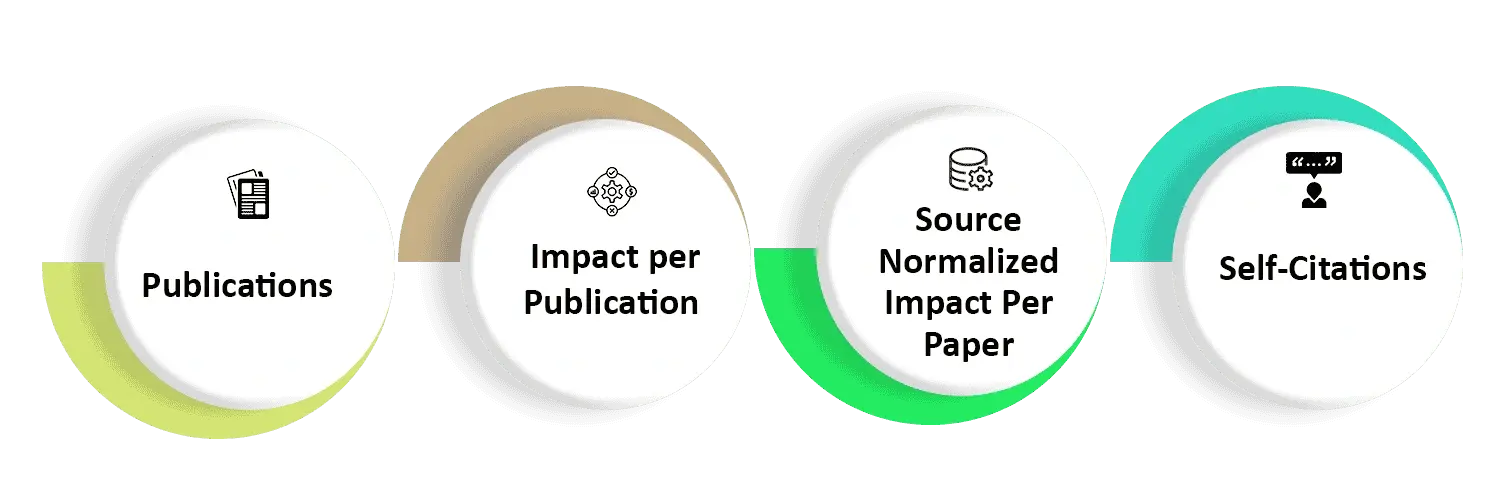
Publications (P): The total number of articles published in the journal measures the volume of output.
Impact per Publication (IPP): This metric expresses the average number of citations per publication in a given time span. It also provides the measurement of the impact created by every publication.
Source Normalized Impact Per Paper (SNIP): Equalizes citation patterns for different disciplines, making it possible to compare citation performance between journals in different disciplines.
Self-Citations: It calculates citations from the same journal, which can be used for detecting potential citation inflation.
These metrics show a journal’s influence in context, adjusting for field differences, in addition to what the impact factor reveals.
Journal-Level Operational Metrics (Non-Citation Indicators)
These kinds of metrics give authors information regarding the operations of the journal. The data are journal-level indicators, free of evaluation. They include:
-
Submission to first decision: Time taken from manuscript submission to the initial editorial decision.
-
Submission to acceptance: Total duration from submission until final acceptance.
-
Acceptance rate: Percentage of manuscripts accepted for publication.
-
Acceptance to publication time: Time from acceptance to the formal publication of the article.
Understanding the metrics helps authors in journal submission and expectations. This is the efficiency or transparency in the journal’s processes and not the value or impact of the articles.
Challenges Associated with the Impact Factor
There are some methodological limitations of the impact factor as well. These
-
Influence of review articles: Cite most frequently, pulling averages toward them.
-
Self-citation effects: Overcitation could result in an elevated Impact Factor
All of these elements underscore the importance of informed interpretation against the background of the journal being reviewed, rather than employing the Impact Factor as an absolute metric of journal quality. This is where professional journal publication support plays a critical role. Our Expert assistance helps researchers assess journals beyond Impact Factor by evaluating scope alignment, indexing status, editorial credibility, and ethical standards, ensuring informed journal selection and stronger publication outcomes.
Field-Based Differences in Impact Metrics
Impact factor expectations vary across disciplines:
-
Life sciences and medicine: Higher citation density, faster accumulation, generally higher IF.
-
Humanities and social sciences: Slower citation accumulation, typically lower IF.
This underscores the importance of discipline-specific benchmarks. Evaluations should always compare journals within the same field to remain meaningful.
Responsible Use of Impact Factor in Research Decisions
Best practices for using Impact Factor responsibly include:
-
Combining IF with SNIP, IPP, acceptance rate, and journal scope.
-
Using journal metrics primarily for journal selection, not for evaluating individual research or authors.
-
Interpreting metrics analytically, without prescriptive judgment.
This approach ensures balanced, evidence-based decision-making while avoiding misapplication of the Impact Factor.
Conclusion
Impact factor is a useful but incomplete measure of journal-level citation impact. No single metric can adequately define research quality. A contextual, multi-metric approach provides a more accurate and field-sensitive understanding of journal influence, supporting informed academic decisions without overreliance on impact factor alone.



 By John