How to Do Citation in a Research Paper: University Rules & Academic Standards
Citations go beyond mere formatting; they are an academic skill that can make or break your research paper. Though many authors may have a basic understanding of citations, few people may fully understand how citations as an academic parameter are assessed at universities or during evaluation. Learning how to do citations for your research paper is essential for passing thesis approval, passing the viva examination, or publishing in journals. This guide fills the knowledge gap between the citation basics that you might already be aware of and the level that is required in academic environments such as those in universities.
How Universities Define “Correct Citation” in Research Papers
Understanding citation from an academic evaluation perspective is crucial. Universities treat citations as evidence of scholarship, source credibility, and technical accuracy, not just formatting. Examiners and reviewers check:
-
Whether in-text citations align with reference lists.
-
The authority and relevance of sources.
-
Correct placement, sequencing, and style consistency.
-
Balance between original content and referenced material.
Correct citation influences thesis approval, viva examination, and journal screening, making it a technical skill rather than a mere formal requirement.
Citation vs Reference vs Bibliography
Accurate academic writing relies on understanding the distinctions between citation, reference, and bibliography. Each element serves a precise evaluative function, ensuring that research is credible, verifiable, and aligned with university standards.
Citation: Citation means giving credit to the original source of an idea, quote, or information. It shows that your work is based on reliable references, not guesswork. Using citations helps avoid plagiarism and builds trust with the reader
Reference: Complete citation details are provided in the reference list so that readers and examiners are able to check the source.
Bibliography: A list of all sources referred to during the course of study, whether or not directly quoted, is required only if university regulations stipulate its requirement.
Primary Source Citation vs Secondary Source Citation
Universities prefer primary sources. Secondary citations are often discouraged because examiners can trace errors or misinterpretations. Always verify the original study before citing; indirect citations should be clearly marked if unavoidable.
Self-Citation Rules in Universities and Journals
Self-citations are acceptable within limits. Overuse can be flagged as bias or manipulation. Follow discipline-specific guidelines to avoid crossing the red line.
How to Do Citation in a Research Paper According to University Standards
Mastering how to do citations in a research paper is essential for meeting university standards and ensuring academic credibility. Correct citation not only prevents plagiarism but also demonstrates technical rigor and scholarly discipline.
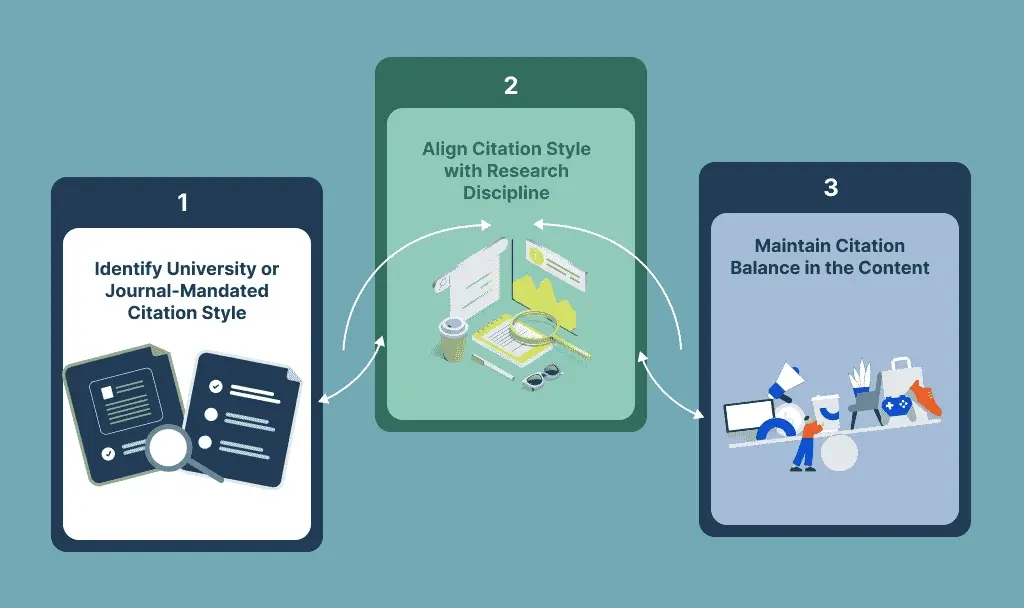
Identify University or Journal-Mandated Citation Style
Check your university or departmental guidelines. Some universities follow stringent preferences for APA, IEEE, Chicago, or Vancouver citation styles, apart from some extra journal preferences.
Align Citation Style with Research Discipline
The choice of citation style must align with your research discipline, as universities evaluate adherence strictly.
Selecting an incorrect style can result in automatic deductions or requests for revision, highlighting the importance of discipline-specific compliance.
Maintain Citation Balance in the Content
Proper citation is not limited to stylistic accuracy but also involves the effective distribution and integration of sources within the research content.
Technical Citation Rules Universities Rarely Explain to Scholars
Many citation errors occur not due to ignorance of style guidelines, but due to a lack of awareness of technical citation rules rarely explained to scholars. Understanding these rules is essential for meeting university evaluation standards and avoiding preventable revisions or rejections.
Citation Synchronisation Rule: In-text citations must exactly match reference list entries; mismatches indicate weak citation control and technical inaccuracy.
Citation Chronology Rule: Recent sources are prioritised, while foundational studies are cited selectively to demonstrate scholarly context and awareness.
Citation Authority Weight: Indexed, peer-reviewed sources carry higher academic value and significantly influence university evaluation and journal decisions.
Citation Errors That Lead to Thesis Revision or Journal Rejection
When scholars understand how to do citations in a research paper, mistakes in citation can lead to corrections in a thesis or even its rejection when it is submitted for publication in a journal synopsis for a thesis because:
-
In-text citations and reference list entries do not match.
-
Excessive use of secondary sources instead of original research.
-
Ignoring citation rules specific to the academic discipline.
-
Using too many or too few citations weakens the argument.
-
Citing sources without evaluating their academic credibility.
Most of these issues can be prevented by carefully following university citation standards and performing basic technical checks before submission.
How Universities and Journals Detect Citation Issues
Universities and journals actively evaluate citations to ensure academic accuracy and credibility. Citation issues are identified through examiner review, reference cross-checking, and editorial screening processes.
Citation Tools vs Actual University Expectations
The use of citation generators may be helpful, but in themselves, most are not acceptable at university or journal level. They tend to miss discipline-specific regulations, the proper sequence of information, and minor details of format. Because of this, it is important that manual checks are made, being thoroughly checked for accuracy and consistency.
Final University-Approved Citation Checklist for Research Papers
Use it to double-check accuracy, consistency, and credibility because good ideas deserve clean citations and zero drama, with reliable research paper assistance when you need it.
Before submitting a research paper, scholars should ensure that:
-
The citation style mandated by the university or journal is followed precisely.
-
All in-text citations correspond accurately with reference list entries.
-
Primary sources are cited wherever possible to demonstrate direct engagement with original research.
-
Discipline-specific citation conventions are applied consistently.
-
Self-citation is used responsibly and within acceptable academic limits.
-
Citation chronology and source authority are carefully verified.
-
Citation tools are used only as guidance, not as the final authority.
Conclusion
Mastery of how to do citations in a research paper itself strengthens academic credibility and the research acceptance ratio at the university. Citation, in the case of a university, works like an evaluative quality metric determining the thesis approval, viva confidence, and even journal publication. The scholar who knows technical citation rules, not just the format, shows rigor, discipline, and academic authority.



 By John