How to Write a Discussion in a Thesis with Examples and Tips
Understanding the way to write a discussion in a thesis is often where students struggle the most, even after completing their research. In this blog, we covered “How to Write a Discussion in a Thesis with Examples and Tips” so that you don’t get stuck while writing your thesis.
And yes, Most learners encounter difficulties with result interpretation, structuring the argument, and being coherent. Therefore, it is crucial to understand this component. In case you are not confident about this part of your writing, consulting a professional will be helpful for you.
Discussion Section in a Thesis
In the discussion section, you explain the meaning of your research findings and connect them to your research objectives. It helps readers understand the significance and implications of your results clearly.
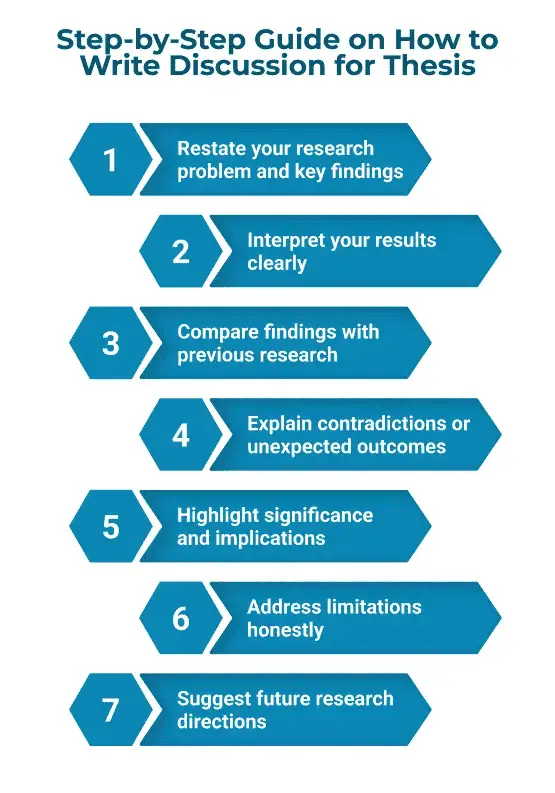
Step-by-Step Guide on How to Write Discussion for Thesis
Writing a strong discussion section requires clarity, and critical thinking to explain, compare, and evaluate your research findings effectively when learning how to write a discussion in a thesis.
Step 1: Restate your research problem and key findings
Writing the discussion section of your thesis begins with restating your research problem and the major findings related to your topic. This helps readers connect with your research purpose and understand the focus of your discussion section
Step 2: Interpret your results clearly
The second thing to do when writing the discussion section is to explain your findings in a straightforward manner. This is one of the crucial activities that should be undertaken when learning to write a discussion section in your thesis, since the technique will assist you in demonstrating that you are an analytical enhancer of your learning as a researcher.
Step 3: Compare findings with previous research
Compare your results and the available research and literature. Stress the points of agreements (or) contradictions to show that your work can be incorporated into the large research scope and give your authority as a researcher.
Step 4: Explain contradictions or unexpected outcomes
Don’t ignore unusual or unexpected findings. Instead, explain them clearly by discussing possible reasons and context that may have influenced the results. This shows honesty and adds depth to your analysis.
Step 5: Highlight significance and implications
Clearly explain why your findings matter. Discuss their theoretical, practical, or social importance to show how your research contributes value and can influence future work or real-world applications.
Step 6:Address limitations honestly
Acknowledge any limitations in your study, such as sample size or methodology. Transparency enhances the level of credibility and demonstrates to the outside world that you are aware of the limits to which your research findings can be trusted.
Step7: Suggest future research directions
Conclude with recommendations of the gaps or shortcomings of areas to explore in future research. This will be forward-thinking and will assist other researchers to expand on your work improving the overall contribution of your research.
Simple Examples of a Well-Written Discussion Section
Example 1: Interpreting Your Main Findings
The study reveals improved performance upon the implementation of the new strategies. It is therefore clear that the study establishes the importance of planning in relation to performance. It is at this point that the research objective is well understood.
Takeaway: Explain what your results mean in simple terms and connect them to your research goal.
Example 2: Comparing with Previous Studies
The study aligns with previous research; however, slight deviations in the findings may be due to differences in the study samples.
Takeaway: Show how your results are similar or different from existing research.
Example 3: Explaining Unexpected Results
Some results did not turn out as expected, possibly due to external factors. These require further explanation to maintain the credibility of the study.
Takeaway: Don’t ignore unexpected results; explain the reasons.
Example 4: Highlighting the Importance of Findings
The findings have practical implications for use in the real world, thus the research is important and relevant for future research and decision-making processes.
Takeaway: Always explain why your findings matter.
Combined Example
The findings of this study indicate that consistent study habits significantly improve academic performance, directly addressing the research objective. This supports the idea that regular engagement with learning materials enhances understanding and retention.
These results are consistent with previous studies that highlight the positive relationship between study frequency and academic success, although the degree of improvement observed in this study is slightly higher. This difference may be due to variations in study techniques or participant motivation.
However, some unexpected results were observed, as a few students who studied regularly did not perform well. This may be explained by ineffective study strategies or external factors such as stress and time management issues.
Overall, these findings are important because they emphasize the role of consistent and effective study habits in academic success. They provide valuable insights for educators and students, suggesting that improving study methods could lead to better learning outcomes. Future research should explore the impact of different study techniques in greater detail.
How to Connect Discussion with Conclusion
When you write your discussion section, it should naturally move towards the conclusion. The discussion should not present the same points again. Instead, focus on clarity and the main results obtained. The transition from the discussion to the conclusion should be smooth.
Example:
These findings emphasize the significance of strategic planning in attaining consistent research results. Therefore, the study concludes that the role of effective implementation cannot be overlooked in the long run.
If you’ve written your discussion but feel uncertain about it, reach out to us. We’ll help you refine it.
Improve My Discussion Section
Why Our Experts Are Ideal for Your Thesis Discussion Formatting
If you are learning how to write a discussion in a thesis or how to write a discussion for a thesis, our experts can guide you effectively. We help students structure, interpret, and present findings clearly
Expert Understanding of Academic Guidelines
Our staff is highly qualified in academic rules which ensures your discussion section meets university requirements and remains clear, well structured and properly written in an academic style.
Precise Structuring of Discussion Content
We organize your discussion content in a logical way so your arguments are clear easy to follow and presented in a well structured and coherent thesis format.
Strong Alignment with Research Objectives
We ensure every part of your discussion directly connects with your research questions and overall thesis aim keeping your work focused, relevant and academically strong.
Clear Interpretation of Results
We turn your raw findings into meaningful insights and explain them clearly so readers understand the importance and value of your research outcomes effectively.
Personalized Formatting Based on Your Research
We customize formatting based on your topic methodology and study needs making your discussion section unique, engaging and aligned with your research work.
Quality and Timely Delivery Assurance
Our team ensures your work is delivered on time with accuracy and consistency while maintaining high quality standards throughout the entire process of your thesis writing.
Struggling to Validate Your Discussion Section? Reach Out to Ondezx Experts
We understand how students often find themselves in a dilemma, thinking, "I have completed my discussion section, but is it actually correct?” Well, this is quite normal!
Our professionals enhance your discussion section for structure and clarity, ensuring it meets academic standards, while evaluating whether it’s strong as it is or needs further refinement. We are a solid consulting firm that can guide and provide assistance at the concluding thesis stages. We suggest that you seek our help before submitting your work to ensure that your discussion section is well-written, academically acceptable, and follows proper methods for how to write a discussion for a thesis.




 By John