How to Write an IEEE Paper: A Complete Step-by-Step Guide
This guide walks you through the step-by-step process of how to write IEEE paper, from choosing a clear and focused research topic to completing the entire process with clarity. Each step is designed to help you stay organized, understand requirements easily, and remain focused throughout your academic journey.
Many scholars require professional assistance because it is not easy to comprehend how to write an IEEE paper effectively. From selecting the right methodology to conducting a comprehensive literature review and presenting ideas clearly, the process can be challenging. With the support of highly qualified experts, your paper becomes academically strong, well-structured, and convincing, improving approval chances while saving valuable time.
The reasons scholars seek research and PhD assistance are explained below
Understanding the format is the first step in mastering
Understanding the format is the first step in mastering how to write ieee paper effectively. It ensures your research is presented in a clear, professional, and globally accepted structure.
-
Follows a standardized structure including title, abstract, introduction, methodology, results, and references
-
Uses a two-column layout to present content in a compact and easy-to-read format
-
Applies strict rules for headings, fonts, spacing, and alignment to maintain uniformity
-
Requires accurate numbered citations and properly formatted references for credibility
-
Improves clarity and readability, making it easier for reviewers to understand your work
-
Ensures consistency across sections, giving your paper a logical flow
-
Enhances academic credibility by following globally recognized standards
-
Increases acceptance chances in journals and conferences by meeting IEEE guidelines
Step-by-Step Process to Structure an IEEE Research Paper
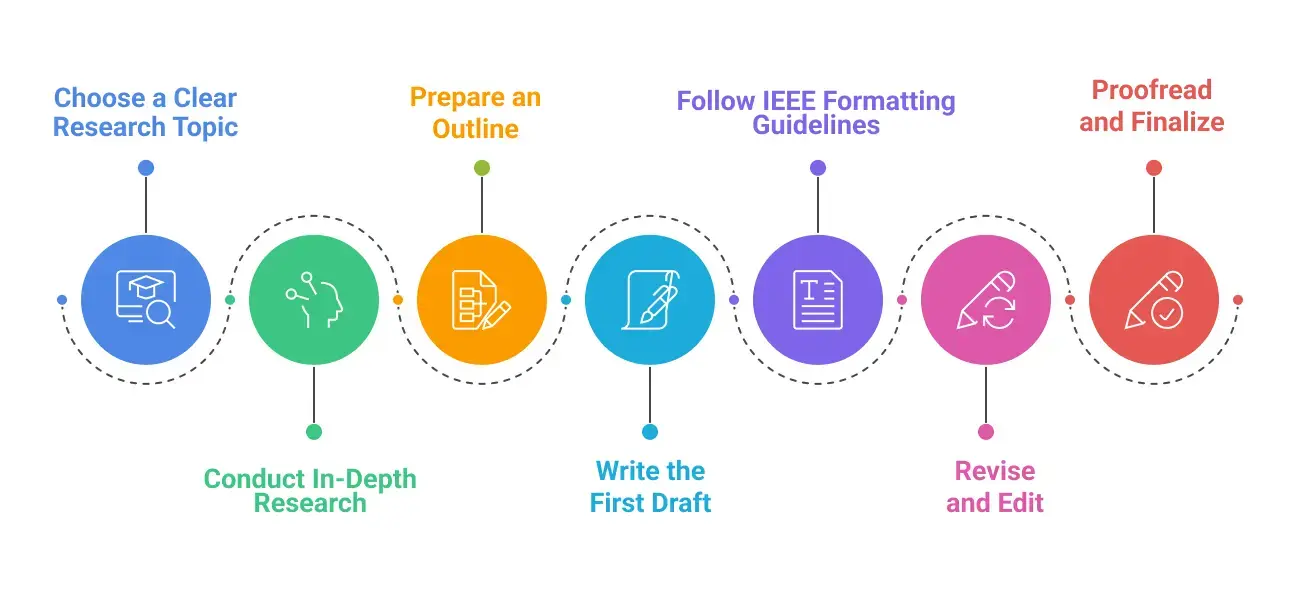
Mastering how to write ieee paper involves a series of steps. The following steps will guide you through the IEEE paper writing process. By following these steps, you can produce a quality IEEE paper that increases the chances of getting published.
1. Selection of Research Topic
The selection of the research topic is the first step in the IEEE paper writing process. The selected topic should be relevant, focused, and interesting. The topic should address the problem, provide fresh insights, and align with the current trends in the field of study.
2. In-Depth Research:
The next step in the IEEE paper writing process is in-depth research. You should collect data from credible sources like journals, conferences, and IEEE publications. The collected data should be analyzed critically, which will help you address the research topic effectively.
3. Prepare an Outline
The final step in the IEEE paper writing process is preparing an outline. In this step, you should prepare an outline that includes the details of the sections that will be discussed in the IEEE paper. The sections include the abstract, introduction, methodology, results, and discussion.
4. Write the First Draft
Write the first draft of the paper, emphasizing the clarity of ideas and the presentation of the research findings. At this stage, you should not worry too much about grammatical or minor errors, nor should you focus too much on the format.
5. Follow IEEE Formatting Guidelines
Use the IEEE guidelines for the format of the headings, fonts, spacing, margins, citations, and the use of two columns. Proper formatting not only makes the paper more readable, but it also enhances the professionalism of the paper.
6. Revise and Edit
Revise the first draft of the paper, ensuring that the ideas presented are clear, the content is coherent, and the arguments are strong. In addition, the narrative should align with the purpose of the research.
7. Proofread and Finalize
The final step is to proofread the paper and ensure there are no grammatical, spelling, or formatting errors. The citations and references should also be in the IEEE format to increase the chances of approval.
Key Components Every IEEE Paper Must Include
Every paper published in IEEE has a structured format to ensure the research is communicated professionally.Understanding the key components will be helpful for learning how to write ieee paper effectively.
Title: A short and informative title that reflects the content of the research and its contribution to the existing literature.
Abstract: This section provides a summary of the research goals and objectives, methodologies, major findings, and the significance of the paper.
Keywords: These are the relevant terms added to assist in indexing and to enable readers to easily find the paper.
Introduction: This section introduces the research problem, objectives, and background, providing a purpose for the research.
Methodology: The methodology will describe the research design, tools, techniques, and procedures used for obtaining accurate and reliable results.
Results and Discussion: The research findings presented clearly, along with the analysis and significance of the research carried out.
Conclusion: The conclusion summarizes the main findings, contribution, and limitations of the study, and finally, it indicates potential future research directions.
References: The references list all sources used in the study, making sure to cite them properly according to IEEE style, ensuring academic integrity and credibility.
Why Scholars Prefer Ondezx for Academic Assistance
Scholars trust Ondezx to simplify IEEE paper writing with expert guidance and reliable support. We focus on saving time, improving quality, and boosting acceptance rates for every researcher.
-
Free IEEE paper topics for seminars, conferences, and research projects.
-
Customized writing tailored to your research area, goals, and requirements.
-
Expert support from professionals across engineering, IT, and science domains.
-
Complete IEEE format compliance including structure, citations, and layout.
-
Unlimited revisions to ensure your paper meets expectations.
-
Reviewer-based corrections to improve clarity and acceptance chances.
-
Continuous editing and approval support from drafting to final submission.
-
Fast-track delivery within 100 hours without compromising quality or originality .
Conclusion
We have explained how to write ieee paper step by step. It is vital to understand the significance of proper structure and format while writing an IEEE paper. Systematic writing, proofreading, and proper organization are vital to write a quality research paper.
At Ondezx, we are dedicated to providing expert support to ensure your paper is accurate, authentic, and compliant with IEEE guidelines at every stage, from topic selection to final submission, focusing on achieving clarity, precision, and academic acceptance in journals and conferences.
Frequently Asked Questions
1. How do I start writing an IEEE research paper?
Begin with a focused topic conduct thorough literature review and prepare a structured outline for guidance.
2. How long does it take to complete an IEEE paper with Ondezx?
Completion depends on complexity standard papers take few days urgent papers delivered within 100 hours.
3. Can Ondezx help me write a customized IEEE paper?
Yes, we will develop a completely customized IEEE Research Paper as per your research needs and requirements.
4. What are all the benefits you will provide?
We provide expert guidance IEEE compliance revisions reviewer corrections continuous editing plagiarism-free and fast delivery.
5. How to choose a research-worthy IEEE paper topic?
Select topics addressing current challenges offering novel insights with academic significance and alignment to your expertise.



 By John