Cyber Security Research Paper: Topics, Insights, and Expert Guidance
The cybersecurity research paper plays a crucial role in today's threat-driven digital economy. Amidst this concern, the global cybercrime losses are projected to cross USD 10.5 trillion annually, and in India alone, the record million of cyber incidents each year across banking, government, and healthcare systems. Writing a cybersecurity research paper strengthens academic credibility, supports high-impact publications and also enhances career growth in research, security engineering and policy roles.
More than an academic credential, it helps you to turn research into a practical solution to real cybersecurity problems. This blog explores types of cybersecurity research, emerging cybersecurity research paper topics and key publication and research opportunities of scholars and professionals.
What Is a Cyber Security Research Paper?
A Cyber Security Research Paper is an organised academic document that methodologically examines digital threats, defence mechanisms, and secure system architectures. The main goal of the cybersecurity research paper is to identify limitations, analyse attack patterns, propose remediation strategies, or validate security frameworks through empirical or theoretical methods.An effective paper also identifies research gaps, enabling scholars to advance knowledge rather than replicate existing findings.
It is important to distinguish between:
Academic cybersecurity research: Focuses on theory, models and validated methodologies. These studies are peer-reviewed and aimed at expanding foundational knowledge.
Industry or applied cybersecurity research: Addresses real-world challenges, including practical tools, system deployment and operational security issues.
Both approaches are crucial for strengthening digital ecosystems, combining theoretical understanding with practical solutions to enhance cybersecurity across academia and industry.
Why Cyber Security Research Papers Matter in Modern Digital Systems
Cybersecurity research plays a pivotal role in safeguarding critical infrastructure, financial systems, healthcare records and governance platforms. Incidents like ransomware attacks on hospitals or data breaches in banking systems highlight the need for evidence-based security solutions supported by rigorous research and a strong literature review in research.
-
Informing secure system and network architecture design.
-
Guiding national and organisational cybersecurity policies
-
Driving innovation in detection, prevention and response technologies.
-
Supporting compliance with global security and privacy regulations.
An extensive literature review on research is an additional step to solidify this base by contextualising all the available knowledge and creating gaps where innovations can be made.
Top Cyber Security Research Paper Topics- Recommended Research Ideas
Selecting the right topic impacts paper acceptance, citation potential and overall research influence. High-impact topics address unresolved security challenges, emerging technologies and real-world threats while aligning with available datasets and tools.
Below are recommended domains with problem-oriented research ideas to guide focused inquiry.
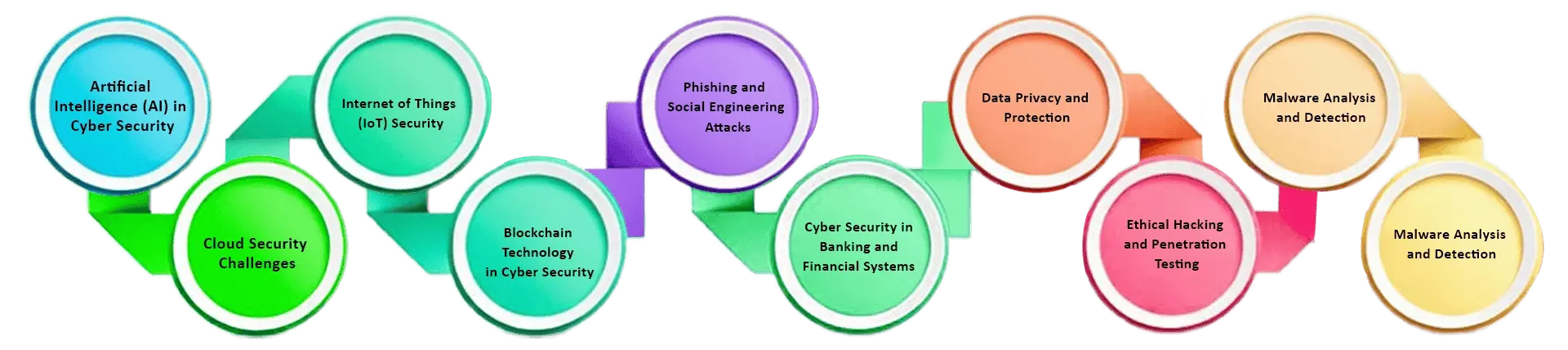
Artificial Intelligence (AI) in Cyber Security
AI has transformed intelligent threat detection, predictive analytics, and automated defence systems, while also introducing malicious threats.
Research ideas:
-
AI-powered interruption detection systems protect against zero-day attacks
-
Machine learning techniques predict the spread of ransomware across networks
-
Practical limitations of AI-driven or automated incident response frameworks
-
Mechanisms of Adversarial AI in Evading Malware Detection
-
Understanding bias and false positives in AI security tools.
-
Using explainable AI to guide cybersecurity decisions.
-
Building AI resilience against data poisoning attacks.
-
Comparing supervised and unsupervised threat detection.
-
Considering the ethical implications of autonomous cyber defence.
-
Balancing speed and accuracy in AI-powered security models.
Cloud Security Challenges
Cloud adoption has expanded attack surfaces through misconfiguration and shared responsibility models.
Research Ideas:
-
Impact of cloud misconfigurations on enterprise data breaches.
-
Effectiveness of identity and access management in multi-cloud environments.
-
Encryption challenges in cloud data storage and transit.
-
Compliance risks in cross-border cloud deployments
-
Implementing zero trust in cloud environments
-
Understanding insider threats in cloud service models
-
Automating cloud security structure management
-
Adopting secure containerisation strategies
-
Recognising the limits of cloud forensics and incident response
-
Risk assessment models for hybrid cloud systems
Internet of Things (IoT) Security
The rapid growth of IoT ecosystems has introduced significant challenges for businesses and researchers. Scalability issues, diverse communication protocols, and privacy concerns are among the top hurdles due to the variation of connected devices.
Research ideas:
-
Security vulnerabilities in resource-constrained IoT devices
-
Botnet formation through insecure IoT protocols
-
Lightweight encryption techniques for IoT environments
-
Privacy risks in smart healthcare devices
-
IoT authentication mechanisms at scale
-
Firmware update security challenges
-
Blockchain-enabled IoT security frameworks
-
Intrusion detection models for IoT networks
-
Regulatory gaps in IoT security standards
-
Risk modelling for smart city infrastructures
Blockchain Technology in Cyber Security
Blockchain provides a framework for decentralised, enabling secure and transparent transactions without relying on a central authority.
Research ideas:
-
Blockchain-based identity management systems
-
Security flaws in smart contract execution
-
Decentralised authentication frameworks
-
Privacy trade-offs in public blockchains
-
Blockchain for secure data integrity verification
-
Consensus mechanism vulnerabilities
-
Blockchain integration with cloud security
-
Scalability challenges in blockchain security models
-
Forensic analysis of blockchain-based attacks
-
Regulatory challenges in decentralised security systems
Phishing and Social Engineering Attacks
Human-centric attacks remain among the most successful cyber threats. Fraudulent emails, deceptive calls and social engineering exploit human behaviour rather than technical flaws.
Research ideas:
-
Behavioural factors influencing phishing susceptibility
-
Machine learning models for phishing email detection
-
Effectiveness of security awareness training
-
Spear-phishing in corporate environments
-
Social engineering attacks on remote workers
-
Psychological manipulation techniques in cybercrime
-
Multi-factor authentication as a phishing mitigation strategy
-
Detection of voice phishing (vishing) attacks
-
Cultural factors in phishing victimisation
-
Measuring long-term effectiveness of prevention strategies
Cyber Security in Banking and Financial Systems
Financial institutions are prime targets for cybercriminals. They handle vast amounts of sensitive data, including personal information, transaction details and financial records.
Research ideas:
-
Fraud detection models using transaction analytics
-
Biometric authentication security challenges
-
Secure payment gateway architectures
-
Impact of cyber regulations on banking security
-
Insider threats in financial institutions
-
Blockchain for secure financial transactions
-
Real-time fraud detection systems
-
API security in digital banking
-
Risk assessment models for fintech platforms
-
Cyber resilience strategies for financial ecosystems
Data Privacy and Protection
Data protection has become central to legal and ethical cybersecurity frameworks. As data grows in volume and value, ensuring privacy is essential for complying with regulations.
Research ideas:
-
Advanced encryption techniques for sensitive data
-
Privacy risks in big data analytics
-
Secure data sharing frameworks
-
Compliance challenges under GDPR and similar laws
-
Privacy-preserving machine learning techniques
-
Data anonymisation effectiveness
-
Breach impact assessment models
-
Secure data lifecycle management
-
Cross-border data transfer risks
-
Privacy-by-design security architectures
Ethical Hacking and Penetration Testing
Ethical hacking and penetration testing involve proactively probing systems to uncover potential risks before they turn into real security incidents.
Research ideas:
-
Effectiveness of penetration testing methodologies
-
Automated vs manual vulnerability assessment
-
Ethical challenges in red teaming exercises
-
Reporting standards in penetration testing
-
Legal boundaries of ethical hacking
-
Continuous security testing frameworks
-
Tool comparison for vulnerability scanning
-
Human expertise vs automation in testing
-
Metrics for penetration testing success
-
Integration of ethical hacking into DevSecOps
Malware Analysis and Detection
Malware continues to evolve rapidly in sophistication, making traditional detection methods less effective. Modern threats often use code masking, polymorphic behaviour and fileless attack methods.
Research ideas:
-
Evolution of polymorphic and metamorphic malware
-
Static vs dynamic malware analysis techniques
-
AI-based malware detection accuracy
-
Behavioural analysis of ransomware
-
Malware evasion techniques
-
Sandbox limitations in modern malware detection
-
Memory forensics in malware analysis
-
Threat intelligence sharing models
-
Detection of fileless malware
-
Mitigation strategies for advanced persistent threats
Network Security and Future Trends
Networks remain the backbone of foundational digital operations supporting everything from enterprise systems to cloud services and emerging technologies.
Research ideas:
-
Effectiveness of intrusion detection systems
-
Zero Trust architecture implementation challenges
-
Network segmentation strategies
-
AI-driven network traffic analysis
-
Securing software-defined networks
-
Future threats in 5G and beyond
-
Scalability of network defence models
-
Insider threat detection in networks
-
Automated incident response systems
-
Predictive network security analytics
How to Select the Right Cyber Security Research Topic
Choosing the right cybersecurity research topic requires a well-planned evaluation of academic and practical factors.
Key considerations include:
-
Match your skills: Pick a topic that fits your academic level and technical expertise
-
Relevance: Focus on current or emerging cybersecurity challenges.
-
Research gaps: Identify underexplored areas from existing studies.
-
Resources: Ensure access to reference, datasets, and tools.
-
Feasibility: Make sure it is manageable within your time and resources.
-
Publication potential: Consider whether it fits the focus of the target journals or conference.
Common Challenges in Cyber Security Research
Researchers often face several obstacles, including:
-
Rapidly evolving threats – Addressed through continuous literature updates
-
Limited access to real-world datasets – Addressed via simulations or open datasets
-
Tool and resource constraints – Resolved through institutional support
-
Complex technical validation – Improved with expert guidance and testing frameworks
Understanding these challenges helps researchers plan effectively.
Expert Support for Cyber Security Research Paper Development
Professional research paper writing services provide structured research support across the research lifecycle. Expert assistance on writing helps you to ensure technical accuracy, originality and academic compliance.
Our services include:
-
Topic selection and proposal development
-
Research gap identification and literature
-
Methodology design and validation
-
Data analysis and result interpretation
-
Journal formatting and plagiarism compliance
Our service also includes unique advantages, which are potential subject matter experts, domain-specific reviewers and customised guidance.
Conclusion
A well-structured cybersecurity research paper makes a significant contribution to digital safety, academic advancement, and technological innovation. Strong technical rigour, originality and adherence to academic standards are most important for impactful research. With expert support, researchers can overcome complexities and produce high-quality papers which stand out in the competitive academic and professional environments.
Take the next step, strengthen your cybersecurity research with expert guidance and transform your ideas into publishable and high-impact work.




 By John