How to Write an Abstract for a Thesis: A Step-by-Step Guide
Knowing how to write an abstract for a thesis is essential because it gives readers a clear, brief summary of your research. Many students struggle with what to include, how much detail is too much, and how to condense months of work into a few hundred words.
Common pain points include unclear structure, missing key results, exceeding word limits, and failing to show why the research matters.
This guide explains how to write an abstract for a thesis, covering its key elements, the step-by-step writing process, common mistakes, and simple review tips.
What Is a Thesis Abstract?
A thesis abstract is a short summary of the entire research study. It briefly presents the research problem, objective, methodology, main findings, and conclusion. It gives readers a quick understanding of the purpose of the research and its key results without requiring them to read the full thesis.
A thesis abstract consists of 150–300 words, with most academic studies identifying 200–250 words as the standard length used across disciplines. However, this word count differs from university to university, since each institution sets its own formatting guidelines, word limits, structure, and style rules.
What Should a Thesis Abstract Include?
A strong thesis abstract normally covers the following key elements
Research problem or background: It shortly introduces the issue or research gap addressed by the study.
Research objective: A research objective is defined as a clear statement that summarizes the specific goals and aims of a research study.
Research methodology: It clearly states the design, data sources, participants, methods, tools or techniques used.
Key findings: It presents the most important results that give the research objective.
Conclusion: It explains the final findings and the ultimate conclusion of the study ultimately.
Research implications, where relevant: This one highlights how the findings may contribute to research, practice or future studies.
Keywords, if required by the institution: It lists important terms that represent the main concepts discussed in the research.
Steps to Write an Abstract For a Thesis
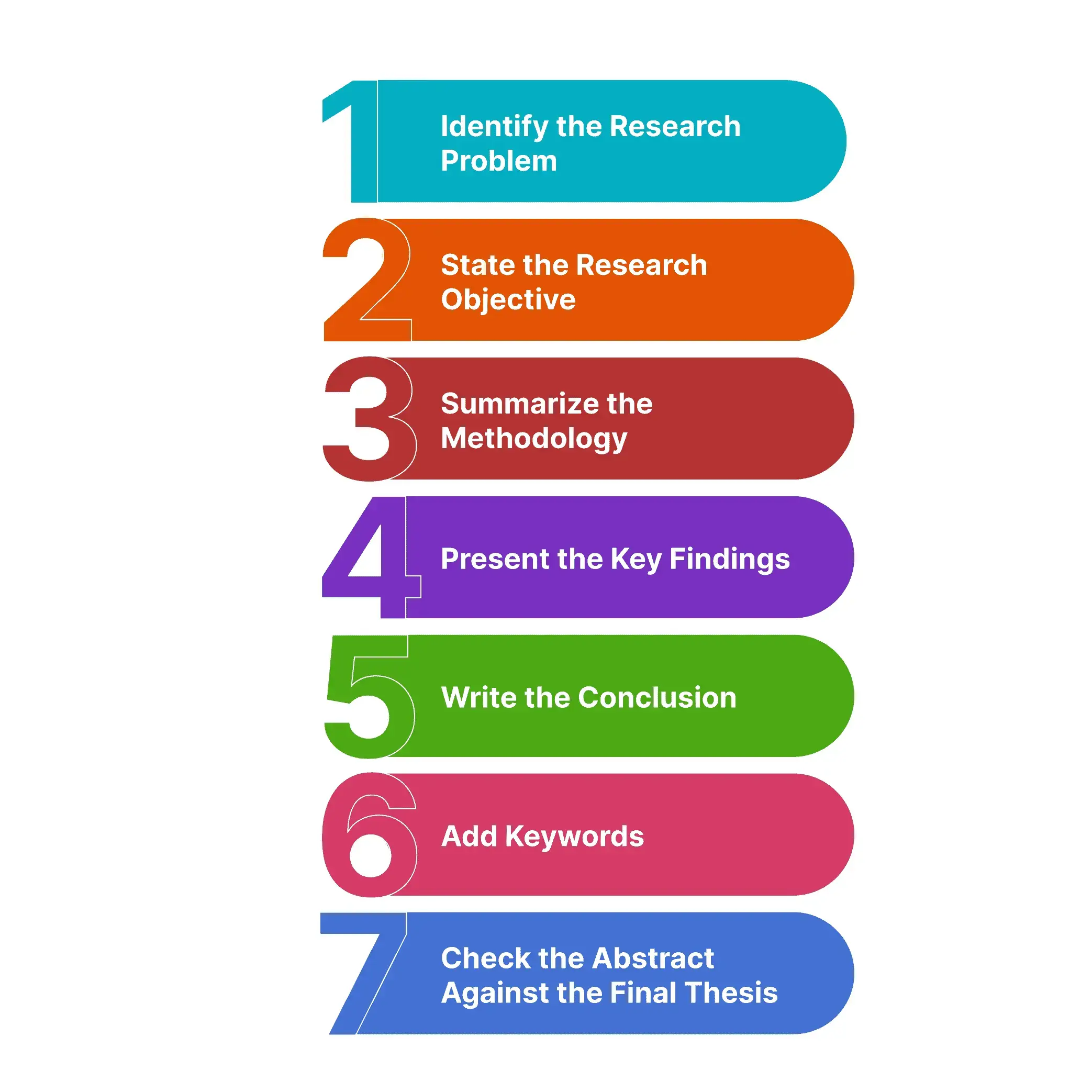
Any scholar can learn how to write an abstract for a thesis effortlessly when the key parts of the research are presented clearly and in a logical order.
1. Identify the Research Problem
The research problem presents the main issue, research gap, or area of concern addressed by the study, with only brief and relevant background information.
2. State the Research Objective
The research objective explains the main aim of the study and clearly identifies what the research intends to investigate, examine, develop, compare or determine within the chosen research area and field of study.
3. Summarize the Methodology
The methodology provides a small overview of the research design, data sources, participants, methods, tools or techniques.
4. Present the Key Findings
The key findings highlight the most important results of the study and its relation with the research objective.
5. Write the Conclusion
The conclusion presents the overall meaning of the findings and the main outcome obtained through the study.
6. Add Keywords
Keywords represent the main concepts and important areas covered in the research and should follow the requirements of the institution.
7. Check the Abstract Against the Final Thesis
A final review checks that every statement in the abstract accurately represents the completed research and remains consistent with the final thesis.
Example for Thesis Abstract
This study aimed to discover the role of artificial intelligence in enhancing students’ learning. It analyzed how learning with the help of new technology influenced students’ engagement, personalization, and academic achievement in higher education. To achieve the goal, a mixed-method research design was applied, which included questionnaire responses, interview data, and performance results. It was found that the role of artificial intelligence is progressive and conditional on the academic engagement of students, the personalization of the educational process, and the strategic use of the technology by an instructor. Thus, the study concluded that the use of such technologies should be carefully considered in every academic setting with due regard for mentioned conditions.
Why Should a Thesis Abstract Be Written at the End?
Overview of the Research
The abstract is generally prepared after the thesis has been completed. At this point the researcher has an overview of the research problem, objectives, methodology, major findings and conclusion.
Focus on Relevant Information
In addition writing it at the end helps the researcher present only the most relevant information in relation to the completed study. Besides, this section reflects the final version of the thesis and does not include any information that will be subsequently changed.
Position of the Abstract in the Thesis
Despite being written at the end an abstract is placed at the beginning of the thesis, usually after the title page. This allows the reader to have an idea about the main focus and outcome of the research before getting familiar with the whole thesis.
How to Review Your Abstract
A careful review helps in knowing that the abstract is accurate, clear, concise, and consistent with your final thesis.
Check Content Accuracy: Confirm that the problem, objective, methodology, findings, and conclusion match your completed thesis. Every statement in the abstract should reflect what the final research actually shows.
Check Clarity: Use simple academic language, with each sentence expressing one clear idea. Avoid long, complicated sentences that make the abstract harder to follow.
Check Word Count: Make sure the abstract stays within the word limit set by your university, department, or journal. If it runs over, trim extra background or method detail first.
Check Formatting: Review headings, spacing, font, and keywords against the academic guidelines you are following. Following the required format exactly helps you avoid unnecessary revisions.
Common Mistakes to Avoid in a Thesis Abstract
Writing Too Early
Writing before the research gets completed can lead to details that do not match the final study.
Excessive Background Information
Too much background can take space away from the objective, findings, and conclusion.
Repeating the Introduction
An abstract should summarize the research instead of repeating the introduction.
Excessive Methodological Detail
Include only methodology details necessary for readers to understand the research approach.
Unsupported Research Claims
Every major claim should be supported by the completed research and its actual findings.
Introducing New Information
Do not introduce results, arguments, or concepts that are absent from the main thesis.
Vague Research Findings
State the main findings clearly instead of using broad or unclear statements.
If you are facing multiple revisions, getting stuck with these mistakes or need to make your abstract stronger, you can reach out to us for support.
How Ondezx Supports Scholars With Thesis Abstract and Writing Guidance
At Ondezx, we provide practical academic support to help scholars develop clear, structured and research focused thesis content.
Understanding Your Research: We start by understanding your research focus and identifying the key details your abstract needs to stay clear and relevant.
Structuring Your Abstract: We organize your abstract so the problem, objective, methodology, findings, and conclusion are presented clearly and concisely.
Improving Academic Clarity: We refine your language and sentence structure while keeping your original meaning and research context fully intact.
Reviewing Research Accuracy: We check that your abstract matches your completed thesis and accurately reflects the research findings you have reported.
Following Institutional Guidelines: We align your abstract with the requirements of your university, department, or journal, including word limit and formatting.
Providing Thesis Guidance: We guide you at every stage of thesis development, based on the specific needs of your research.
Conclusion
Writing a thesis abstract is a critical aspect of research, as it provides a concise representation of the completed study. Knowing how to write an abstract for thesis assists the authors in defining the particular problem that was studied, objective, methodology and key results and conclusion of their work. The keywords can be added if necessary and the abstract should be compared to the final thesis. A good abstract should represent the study accurately without introducing new information or unnecessary details. If you need guidance in thesis development, whether for an abstract, its review, research methodology, or complete thesis guidance, We are here to assist you.




 By John