Quantum Thesis Research and Its Role in Modern Physics
A quantum thesis examines a specific area of research in modern physics and may cover theoretical, computational or experimental studies. It should begin with a clear research problem and a focused question rather than a broad topic. Good quantum physics research also requires scientific accuracy, relevant evidence and a logical structure. A well planned quantum thesis connects the research problem with suitable theories, methods, analysis and conclusions.
Researchers often apply mathematical models, conduct simulations, experiments, or a combination of these approaches to address scientific issues. The present article provides an insight into the primary stages of the quantum thesis writing process, including the problem definition and theoretical framework, methodology selection, analysis of results, chapter organization, and quality maintenance. A clear process helps present complex quantum research in a simple, systematic and academically appropriate way.
In this blog, you will learn how to develop, structure, analyse and present quantum thesis research in a systematic and academically appropriate manner.
Defining the Quantum Research Problem
A quantum thesis should be narrowed down to a specific research or problem rather than a general topic on quantum physics. This will give the study more structure and allow the researcher to identify what exactly he/she wants to accomplish, how one might approach the study, and what the research should entail. A quantum thesis must address the following:
These four components are significant in the paper because they help the researcher stay focused on one particular issue, organize his research, choose the methodology and address a certain problem.
Developing the Theoretical Framework
A strong theoretical framework gives the research a scientific foundation. It connects established quantum concepts with the research question and helps the researcher explain why the selected approach is suitable.
Relevant quantum theories and principles
Relevant quantum theories and principles should be selected according to the research problem. Explain the concepts that directly support the study, such as quantum mechanics, quantum states, measurement, or other relevant principles. Avoid including theories that do not contribute to the research objectives.
Connection between theory and research objectives
The theory should have a clear connection with the research objectives. Explain how each important concept helps answer the research question. This connection makes the study easier to follow and shows how the theoretical foundation supports the selected research approach.
Use of relevant scholarly literature
Using related academic literature will enable the researcher to identify existing theories, find research results, and become familiar with the current state of the discussion on the topic. The academic literature can thus serve as the researcher’s guide to the theoretical basis of the quantum research paper as well as its arguments.
Selecting the Research Methodology
The research methodology is a set of techniques that will be employed to achieve the objectives and answer the posed research question. Therefore, the approach selected to carry out the study should be aligned with the research question, objective, resources available and the nature of the research. Moreover, a specific and detailed method makes the research process transparent and allows the reader to follow and assess the study without confusion.The researcher must adhere to any of the following approaches.
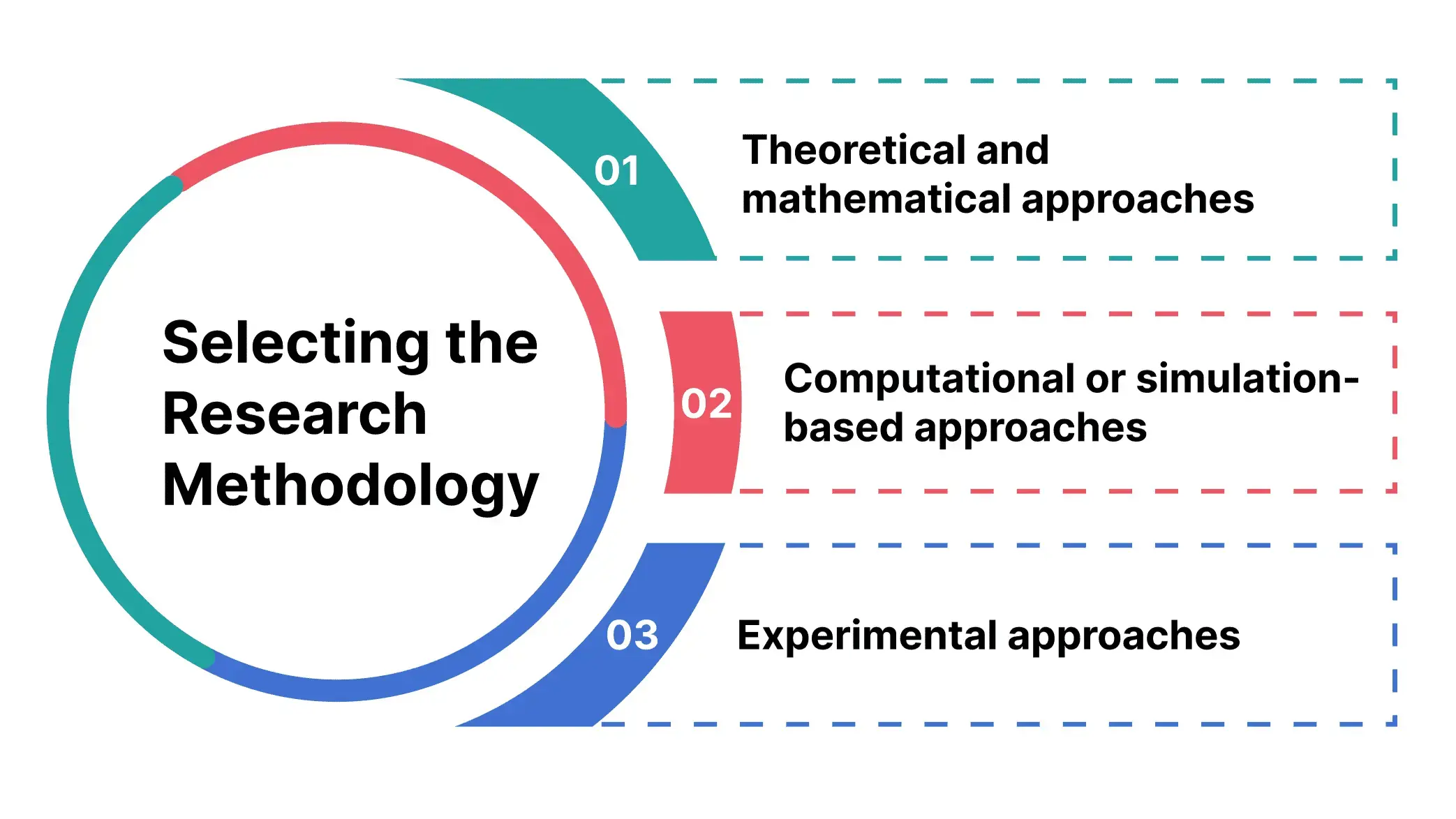
Theoretical and mathematical approaches
Theoretical and mathematical approaches can be used in the study if it focuses on deriving mathematical models or formulas or involves quantum mechanics calculations. In this case, the method part should explain what assumptions, equations, and variables will be used to obtain the expected results.
Computational or simulation-based approaches
If it is planned to use a computational approach to study quantum mechanics, the method part should include the description of the software or computational techniques that will be used, the parameters, the flow of calculations, and the data processing.
Experimental approaches
If the selected research design involves performing laboratory experiments, the method part should include all details of the materials, equipment, steps, variables, and procedures of the planned experiments. Additionally, it should explain how the measurement accuracy and precision will be achieved.
Analysing Quantum Physics Findings
The goal of Analysing Quantum Physics is to present the main theoretical, computational, mathematical or experimental findings and thoroughly explain their meaning in relation to the research question. In this part of the draft, it is of utmost importance to highlight significant trends, patterns or observations instead of just reporting the results of the study.
The results section should also include a comparison of the findings with existing theories or previous research results. By emphasizing similarities and differences you will demonstrate the importance of your research results for addressing the research question and support your conclusions about the relevance of your findings to the research area.
Structuring the Quantum Thesis
A well structured quantum thesis should follow a logical progression from the introduction and literature review to methodology, analysis, results, discussion, and conclusion. Each chapter should have a clear purpose and connect naturally with the next. Consistent headings, explanations, tables, figures and references can make complex research easier to understand.
You can also learn more from our blog on “How to Write a Thesis” for guidance on planning and organising a thesis.
Academic Quality and Research Standards
Technical accuracy, correct citations, consistent research, appropriate formatting, and overall presentation play an equally critical role in the quantum thesis. Equations, concepts, calculations, terminology, figures and results need to be closely verified. Additionally all the research findings that are used in the thesis need to be cited correctly and consistently to avoid plagiarism. Finally the author must follow the university style guide for formatting the thesis, including creating a reference list or bibliography, presenting tables, figures and calculations, among other critical elements.
If you are unsure about how to formulate your quantum thesis or experience difficulties completing it due to the complex instructions. We provide professional thesis assistance to help you structure, refine and complete your research effectively.
How Ondezx Supports You To Make Quantum Thesis Research
Research topic and problem refinement
We help refine the research topic and problem so the study has a clear and manageable direction.
Thesis structure and chapter development
Our team organizes chapters and develops a logical structure that connects the research problem, methodology, findings, and conclusion.
Literature and citation support
We provide guidance in organising relevant literature and using citations consistently to support the academic discussion.
Academic review and final refinement
We review the content for clarity, structure, consistency, academic presentation and final refinement before submission.
Conclusion
Quantum Thesis Research requires a precise research problem, relevant theory, suitable methodology, careful analysis and a logical structure. It also plays a crucial role in modern physics research. Technical accuracy, reliable citations, consistent research and proper academic presentation are also important in publishing the research paper. When professional assistance is needed, the Ondezx team provides support in research direction, thesis development, academic refinement and final review to help present the research clearly and systematically.


 By John