Shodhganga Thesis: How to Search, Evaluate, and Use Theses for Your Research
Many scholars, researchers and academic professionals use Shodhganga to find, review and analyse theses and dissertations related to their research area. A Shodhganga Thesis helps researchers understand earlier research problems, studies, methods, evidence and findings related to their topic. For a beginner searching a large repository it feels confusing. You may find many results that appear relevant but differ in topic, methodology, year or academic discipline. This makes it important to follow a structured approach instead of downloading and reading every thesis.
In this guide, we have explained how to search for relevant theses using both simple and advanced search options, evaluate the documents you find, and apply them to your own thesis writing and research development.
What Is Shodhganga?
Shodhganga is a national site run by INFLIBNET Centre. It was started with support from the University Grants Commission, or UGC. Many universities send in the PhD theses they approve. After that, the complete papers are posted online for anyone to read without paying.
Due to the presence of various disciplines’ literature in a single location, this platform can be beneficial for the researcher at the very beginning of the project when he/she can examine the literature to determine whether the subject matter has already been researched and how scholars approached this research before.
What Researchers Can Find on Shodhganga?
Researchers can find doctoral theses, dissertations, synopses and other research related documents available through the repository. The exact material available can vary by university and record. Hence researchers should examine the individual record and document details before relying on a thesis for a particular purpose.
How to Search for a Thesis on Shodhganga
Step 1: Start With Your Research Topic
Before opening the repository, first identify what you want to search for. Using the right keywords can make the search easier and help you compare relevant studies.
-
Break your research topic into its main concepts.
-
Identify important keywords and related terms.
-
Prepare alternative spellings, synonyms and closely related expressions.
-
Separate the topic, population, variables, location, technology or discipline where relevant.
Step 2: Open Shodhganga
Open the official Shodhganga repository and locate the search area. Depending on the search route that you select, you may find options like
-
Simple Search
-
Advanced Search
-
Google Search
-
Subject Search
The reference article further states that searches may be made by using information such as thesis title, author, supervisor, university, department, subject and keywords.
How to Use Shodhganga Simple Search
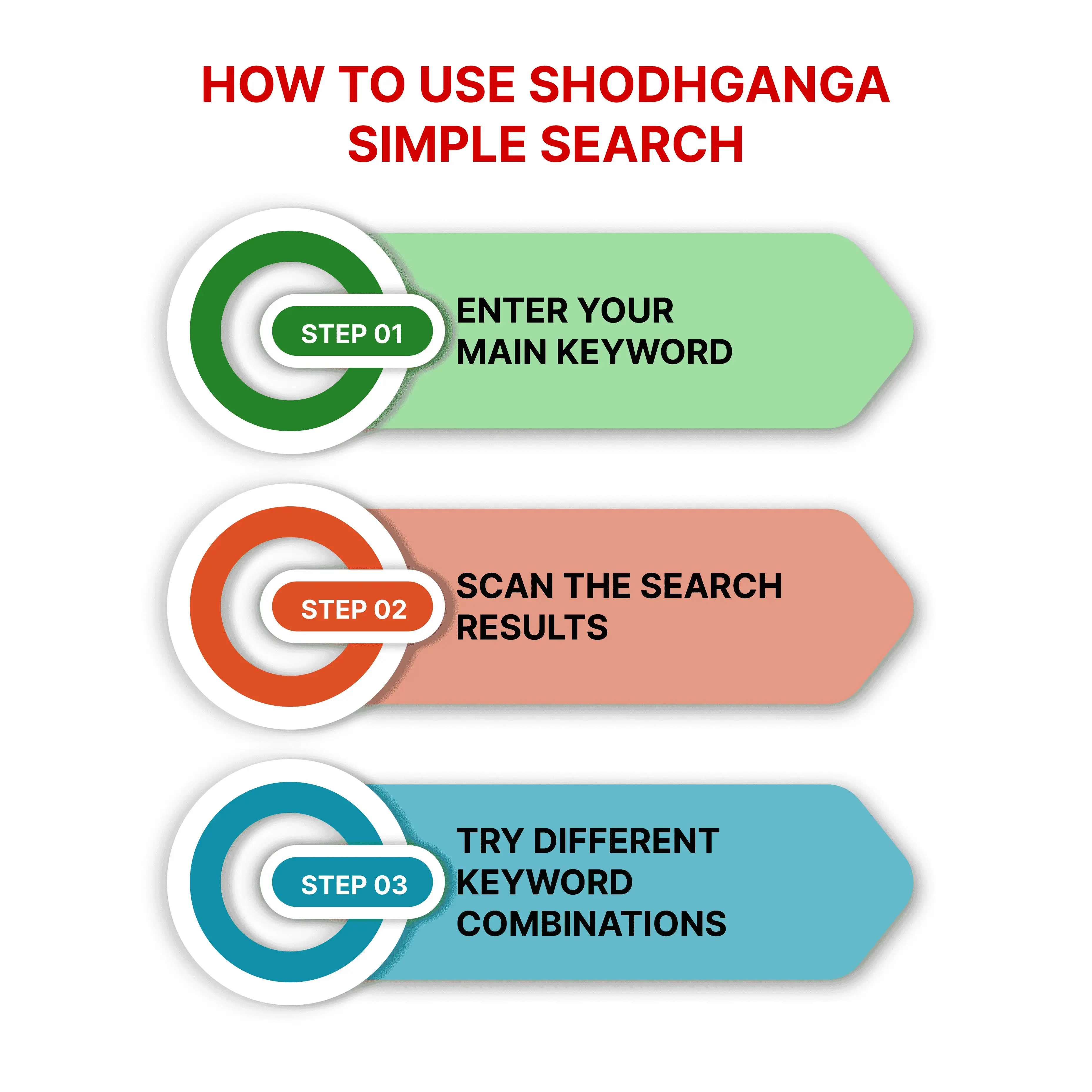
Step 1: Enter Your Main Keyword
Begin with a broad keyword search that is related to your research. Starting with one or two important terms allows you to understand the range of available research before narrowing the search too much. A Shodhganga Thesis can help you identify how previous researchers have approached similar research topics.
For example, If you search for “artificial intelligence” it shows the uploaded date, title, researchers names and guides name.
Step 2: Scan the Search Results
Do not download every thesis that appears in the search results. First review the available details and shortlist the theses that are closely related to your research problem.
Thesis Title: Once you have entered the keyword, you may see a variety of thesis titles related to it, then verify and select the title which is related to your topic.
Author: Once you click on the title it will open a page with the title name, author, university, subject and guide along with a pop up form with a citation link that can be used on your research.
University: It will also show the name of the university, year in which the thesis was submitted and keywords related to the research.
Guide: If you click on the name of the guide it will show the researchers along with their thesis titles that were guided by the guide.
Submission or Publication Year: The year of thesis completion or submission is mentioned.
Available Document Information: Other document details like keywords, a link to the abstract, pagination, URI and department details are also present.
Step 3: Try Different Keyword Combinations
Once you are familiar with it you can use different keyword combinations. Using different combinations is useful because researchers may describe a similar concept with different terminology. A search that uses only one phrase can therefore miss relevant theses. Use the following tips for searching.
-
Search synonyms and related terms.
-
Search individual concepts separately.
-
Try singular and plural forms.
-
Use broader terms when the results are too limited.
-
Use narrower combinations when the results are too broad.
How to Use Shodhganga Advanced Search
Step 1: Open the Shodhganga Advanced Search
Access the Advanced Search page in Shodhganga. The Advanced Search interface provides different options to search for theses and refine the search results using keywords, filters, sorting, and display options.
Step 2: Enter Your Main Search Term
Enter a keyword, research concept, or topic in the search box provided next to For. Choose a search term that clearly represents your research area. For example, you can enter “artificial intelligence in healthcare” and click Go to begin the search.
Step 3: Select the Search Field
Use the first dropdown under Add filters to select the field you want to search. Title is opted when you want to search for a particular term in thesis titles. Other available fields such as Author or Subject, can be selected when you want to make the search more specific.
Step 4: Choose a Search Condition
Select the appropriate search condition from the second dropdown based on how you want the keyword to match the selected field.
-
Equals: Use this when you want the selected field to match the entered search term exactly.
-
Contains: Use this when you want the selected field to contain the entered search term.
-
Not Contains: This is used to exclude records containing a particular search term.
-
Not Equals: This is used to exclude records that exactly match a particular search term.
-
Search Condition: Choose the condition based on the search requirement to refine the results.
Step 5: Add Your Search Filter
Enter the keyword in the search field and click Add. The selected filter will be added to the Current Filters section and will help narrow the search results.
Step 6: Add Multiple Filters
You can combine two or more search conditions to make your search more focused. For example:
To narrow your results effectively, you can combine filters across different fields. For example, set the Title field condition to Contains with the term “Machine Learning”, and simultaneously set the Subject field condition to Contains with “Healthcare”
Adding multiple filters can help you identify theses that are more closely related to your specific research topic.
Step 7: Adjust Results Per Page
Use the Results/Page option to select the number of thesis records to display on each page. For example, the interface shown has 10 results selected per page. You can choose another available option according to your requirement.
Step 8: Sort the Search Results
Use Sort items to organize the search results. In the interface shown, Relevance is selected as the sorting option. You can also use the In order option to arrange the results in the available order, such as Descending.
Step 9: Click Update and Review the Results
After applying the required filters and selecting the results and sorting options, click Update. Review the refined thesis results and open the relevant records for further analysis.
How to Evaluate a Shodhganga Thesis
Identifying a thesis is the first step in any research. Evaluation is important because a document might appear relevant according to the title but significantly differ by many terms of the research. A careful evaluation involves verification of thesis title, author, university, publication/ submission year and key sections.
1. Check the Thesis Title
The thesis title gives an initial understanding of whether the study is relevant to your research topic, problem, variables and context. Any researchers must question the following themselves
-
Does the research topic closely relate to yours?
-
Does it study the same problem?
-
Are the variables similar?
-
Is the geographical or population context relevant?
2. Check the Author and University
Reviewing the author, university, department and research context helps in identifying the research area of study. The details to be noted are
-
Author: Find the researcher who conducted and submitted the study.
-
University: Identify the thesis university of the research.
-
Department/Subject: Identify the academic area related to the research.
-
Research Context: Check the study setting, target population and academic context.
This information helps researchers understand where the study was conducted and which its corresponding academic discipline.
3. Check the Publication or Submission Year
The submission year helps you understand when the research was conducted and how current its evidence may be. Compare older and newer studies rather than rejecting older theses automatically, because older work can provide useful foundational concepts and established methods. In rapidly changing fields, however, recent research usually deserves closer attention.
When evaluating a thesis, consider whether its data, technology, policy environment or theoretical context is still relevant to your research. Year can be used as one factor in your evaluation not as the only basis for accepting or rejecting a source.
4. Examine the Key Sections of the Thesis or Dissertation
After selecting a relevant thesis one can check for its key sections before proceeding to read the entire document. This allows for quickly comprehending the problem, approach, evidence, results and limitations of the work.
Abstract
The initial evaluation of the thesis begins with an abstract which is the main section to find out the exact thesis. In cases where the abstract does not meet the requirements, there is no need to read the entire thesis.
Methodology
The sections like the research design, sample, data collection methods, variables and analysis techniques used by the researcher need to be checked. The methodological choices should be relevant to your research question and whether the study context is sufficiently comparable.
-
Review the research design and justification for selection have to be presented.
-
Check the sampling approach, sample size, and characteristics of participants or data sources.
-
Examine data collection instruments, procedures, variables and analysis techniques.
-
Consider whether the approach could inform, differ from or improve your own research design.
Results and Findings
This is the second main section to consider alongside the abstract. The results and key findings should be consistent with each other. Researchers should analyse the results for the established findings across different studies and identify any unanswered or unresolved questions.
Conclusion and Recommendations
This is the third main section because reading the conclusion gives an overall view of how the author relates the results then research methodology and other sections can be considered. The limitations and recommendations for further research identified by the researcher can also serve as a guide to focus your own research.
References
The reference list will help you identify the journal articles, books, reports and other resources used by the researcher. It is a good source of additional readings. However do not rely only on the information provided by the authors of the thesis. Double-check the information and go through the papers directly to ensure there are no contradictions.
Technical Details & Practical Points
While conducting the literature search using Shodhganga, you should consider the following technical details:
Chapter-wise Downloads: Unlike other global databases which provide only one downloaded PDF file of all the thesis parts, Shodhganga offers thesis documents in chapter-wise PDF format (for example: Title Page, Certificate, Abstract, Chapter 1, Chapter 2, etc.)
Changes in Platform: INFLIBNET may update the search interface UI/UX or even backend (for example, DSpace platform). However, the same parameters and options for the search (Filtering, Conditions, Metadata fields) will always stay the same, though there could be some slight changes in the visual interface.
Universities' Contribution: Availability of the full-text documents is dependent on the contribution from individual universities and UGC compliance timeline requirements.
Common Mistakes Researchers Make When Using Shodhganga Research
Common mistakes made by researchers while using Shodhganga research consist of the following.
-
Searching information with only one keyword or phrase
-
Choosing a thesis on the basis of only its title
-
Searching outdated or irrelevant theses and ignoring the new study
-
Only basing one’s thesis on a single thesis instead of comparing one’s thesis with many similar ones
-
Copying content without citation, using the findings included in a thesis without checking the sources cited in the thesis
-
Not evaluating if the methodology used in the thesis is relevant to their research.
Researchers who are new to the research process might make these mistakes because they lack knowledge of searching, evaluating and synthesizing references. The process will assist them in reducing unneeded rewrites and improving their research at the initial stages.
How Ondezx Assists Scholars and Professors With Shodhganga Research
Ondezx supports scholars and professors in using Shodhganga research as a starting point for developing their own research. Our focus is on helping researchers understand and use existing academic work responsibly rather than treating a thesis as material to copy.
Selecting Relevant Theses
We provide support to scholars and professors in identifying and shortlisting relevant theses based on their research area, keywords, objectives, subject, and study context.
Developing the Research Topic
We help scholars develop a focused research topic based on the information and research findings and approaches identified from relevant studies.
Building the Literature Review
We provide support in organising relevant studies, comparing research findings, identifying key themes, and developing a clear and logical literature-review structure.
Identifying Research Gaps
By comparing multiple studies, researchers can examine differences in variables, methods, locations, datasets, time periods, and findings. We provide guidance to scholars in identifying and understanding research gaps based on these differences.
Developing the Research Methodology
We provide methodological support by reviewing approaches used in relevant theses and helping researchers consider suitable research designs, sampling strategies, data collection methods, variables, and analysis techniques for their own study.
Thesis and Dissertation Writing
We offer support to scholars in developing a perfect academic structure, improving the logical flow of chapters, refining academic language and presenting research findings in a systematic way while keeping the researcher responsible for the original research and interpretation.
Research Paper Preparation
Relevant thesis findings can help researchers understand the background and existing evidence for a topic. We assist in transforming the researcher’s own work into a structured research paper with appropriate sections, academic language, citations, and presentation.
Summary
Reviewing the thesis in Shodhganga helps researchers find existing theses and understand previous work in their research area. A structured search makes it easier to find relevant studies while careful evaluation helps researchers in identifying useful evidence from material that does not fit their study. Researchers can move from thesis discovery to literature review, research-gap identification, methodology planning and stronger academic writing by using the repository thoughtfully. If you need guidance in selecting theses and dissertations for your research Ondezx can assist you in reviewing relevant academic work and developing your research systematically.


 By John