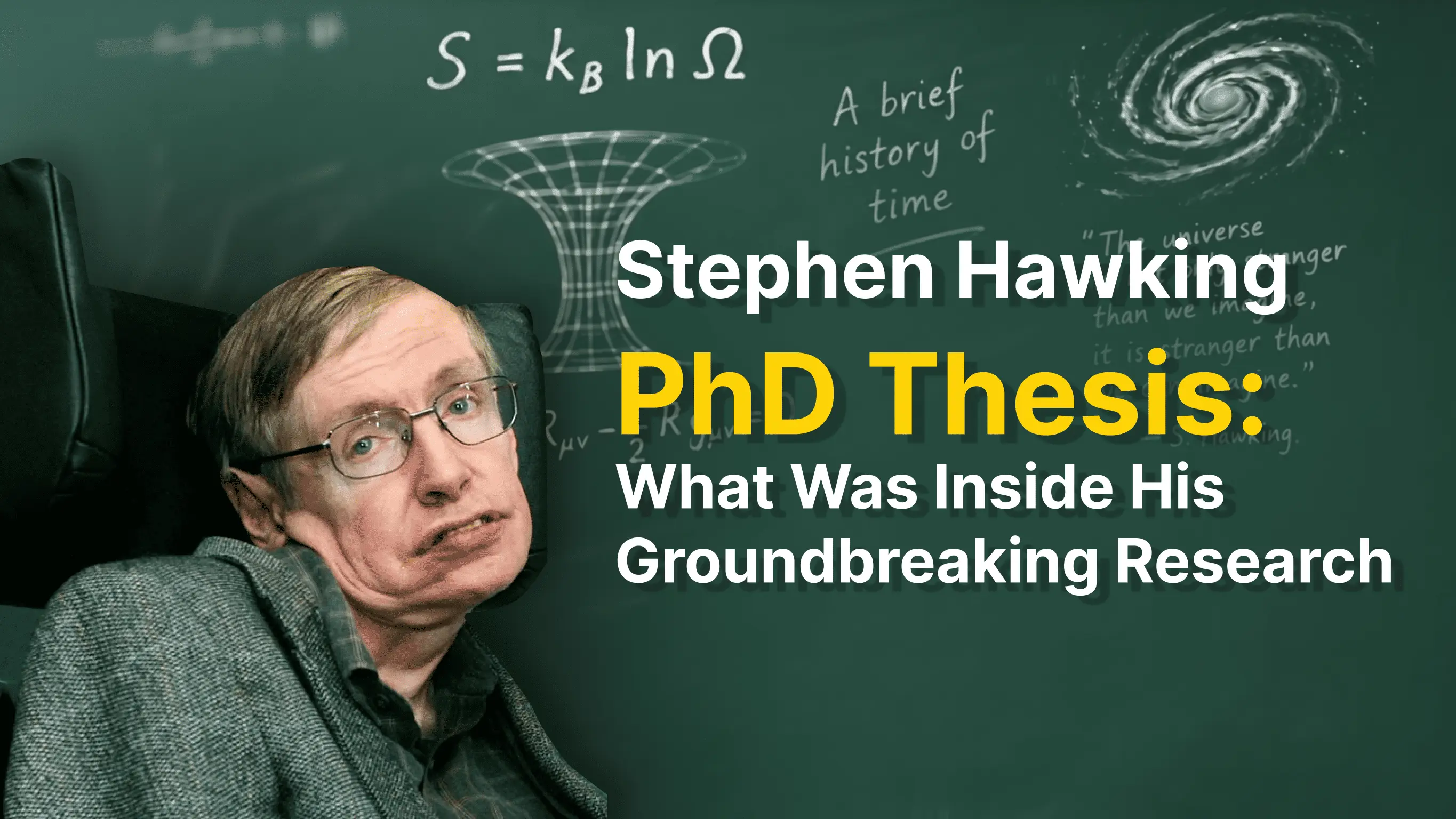
Stephen Hawking PhD Thesis: What Was Inside His Groundbreaking Research
The Stephen Hawking PhD thesis was titled Properties of Expanding Universes. It was submitted to the University of Cambridge in 1965 under the supervision of Dennis Sciama. The research examined expanding universes and problems in cosmology using mathematical methods. The work became an important early part of Hawking's scientific career and was later made available online through Cambridge. The Stephen Hawking thesis provides an example of how a focused research problem can guide a systematic academic investigation.
Quick Facts About the Stephen Hawking PhD Thesis
|
Thesis title
|
Properties of Expanding Universes
|
|
Author
|
Stephen William Hawking
|
|
Institution
|
University of Cambridge
|
|
Supervisor
|
Dennis Sciama
|
|
Year submitted
|
1965
|
|
Degree awarded
|
1966
|
|
Length
|
Approximately 119 pages
|
|
Research topic
|
Cosmology and expanding universes
|
|
Submitted
|
1965
|
|
Online availability
|
Made available online by Cambridge in 2017
|
What Is the Stephen Hawking PhD Thesis About?
The PhD thesis of Stephen Hawking focused on expanding universes and important questions in 1960s cosmology. During that time there was much research done about the origin and behaviour of the universe. Different theories were used to explain gravity and cosmic expansion. Hawking used mathematical analysis to examine these ideas and to study how small changes in density could develop as the universe expanded.
Three main areas were studied in the research:
A Challenge to Hoyle-Narlikar Theory
A mathematical examination was made of the Hoyle-Narlikar approach to gravitation. The work was used to question parts of the theory and to test whether its ideas could remain consistent under the conditions being studied.
Perturbations in Expanding Universes
Small irregularities in the density of matter were examined because of the concept of expanding universe. Such changes are important because they can lead to the formation of large structures such as galaxies.
Gravitational Radiation
The behaviour of gravitational radiation in an expanding universe was also studied. The mathematical treatment helped explain how gravitational waves could be considered within a changing cosmic background.
Who Supervised Hawking's PhD?
Dennis Sciama supervised Hawking's doctoral research at Cambridge. Hawking had initially been interested in working with Fred Hoyle. As Hoyle was unavailable for supervision Hawking was guided by Sciama. Sciama encouraged mathematical investigation and independent thinking which became important in Hawking's research career.
Why Is the PhD Thesis of Stephen Hawking So Famous?
Three main reasons help explain the lasting interest in the thesis of Stephen Hawking.
1. The author's story
At the age of 21 Hawking was diagnosed with motor neurone disease. In spite of the serious diagnosis he continued his academic work and completed his doctorate. His determination added a human dimension to the story behind the thesis.
2. Its link to later discoveries
The early cosmological work was followed by Hawking's later research on singularities and black holes. His work with Roger Penrose became especially important in the development of singularity theory. The doctoral research therefore forms part of a much larger scientific journey.
3. The 2017 open access release
In 2017 Hawking's thesis was made freely available online through the University of Cambridge repository. The release created an impact on increase in public interest and the website experienced heavy demand. The event helped make a highly technical doctoral thesis accessible to a much wider audience.
What Did Hawking Say About Releasing It?
Hawking encouraged a knowledge quest and asked people to have curiosity in knowing about the universe. The online release of his thesis reflected his belief that scientific ideas should be shared with a broad audience. It also helped inspire interest in science and doctoral research.
How Does the Thesis Connect to Singularities?
The thesis is connected to the development of Hawking's later work on cosmological singularities. His early studies of expanding universes provided an important foundation for further research in general relativity. Roger Penrose's work on gravitational collapse also influenced the direction of Hawking's thinking. The Stephen hawking thesis offers readers an example of how complex scientific research can be explored through a structured academic approach.
The later Hawking-Penrose singularity theorems were developed after the doctoral work. They should not be treated as results that were proved in the thesis itself. Instead the thesis can be viewed as an early stage in a research path that later led to major results about singularities.
How Can a Non-Physicist Read It?
You do not need to follow every equation to know the thesis writing importance. A practical reading method can be used.
Start With the Abstract and Introduction to Understand the Research
The abstract and introduction should be read first. The purpose of the research and its main ideas can then be understood before technical sections are studied.
Read Chapter Openings and Conclusions to Follow Key Arguments
The opening and closing parts of each section can be given more attention. They often show what was being examined and what was found without requiring every mathematical step to be followed.
Learn Key Terms Before Reading Technical Sections
Basic terms such as perturbations, gravitational radiation, expansion and cosmological singularities should be understood first. This makes the technical discussion easier to follow.
Read the Thesis as Important Historical Scientific Research
The thesis can also be read as a historical research document. Its ideas can be compared with Hawking's later work to see how scientific thinking developed over time.
What Can PhD Scholars Learn From Stephen Hawking's Thesis?
The Stephen Hawking PhD thesis can be studied as an example of doctoral-level research methodology. Several useful lessons can be applied to research in other fields.
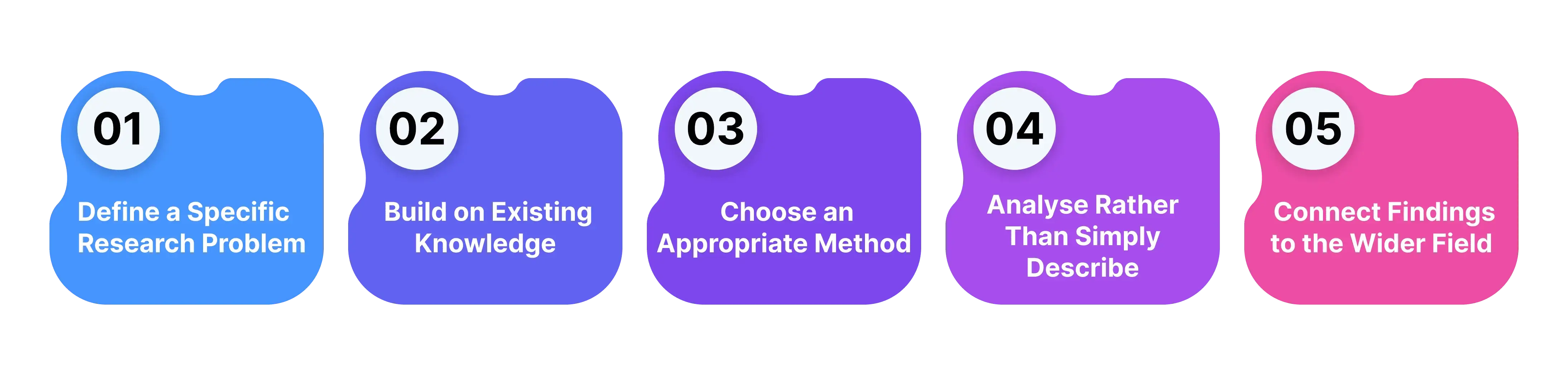
Define a Specific Research Problem
A broad subject should be narrowed into a focused research problem. A specific question makes the study easier to plan and gives the research a strong direction.
Build on Existing Knowledge
Previous theories and studies should be reviewed before new work is started. Research gaps can then be identified and used to shape the study.
Choose an Appropriate Method
The research method should match the research question. Suitable methods help evidence to be collected and analysed in a systematic way.
Analyse Rather Than Simply Describe
Research should go beyond description. Evidence should be examined critically and an original academic contribution should be developed from the analysis.
Connect Findings to the Wider Field
Research findings should be related to the wider subject area. Their value becomes stronger when they add useful knowledge to the existing academic field.
Why Does the PhD Thesis of Stephen Hawking Still Matter?
The thesis of Stephen Hawking remains important because it represents an early contribution to the study of cosmology and general relativity. The work shows how a focused research problem can be examined through mathematical methods and connected to wider scientific questions.
Its importance is also seen in the way Hawking's academic work developed after the doctorate. Research on expanding universes was followed by major studies of singularities and black holes. The thesis therefore provides an example of how doctoral research can become the starting point for a long academic journey.
For current PhD scholars the main lesson is not limited to physics. A meaningful research problem should be focused. Existing knowledge should be studied and suitable methods should be selected. Findings should then be connected to the wider field so that lasting academic value can be created.
Strengthen Your PhD Research With Ondezx
At Ondezx, we provide academic guidance for scholars working on dissertations, theses and research papers as described in Hawking’s thesis lesson. Our PhD Assistance support includes editing, structure review and consultation. Research content can be improved with suitable academic guidance while the scholar's own research remains central. Any researchers can contact Ondezx today to discuss the PhD research needs.
Frequently Asked Questions
1.What was Stephen Hawking's PhD thesis about?
Stephen Hawking's PhD thesis covers the topics on expanding universes and mathematical questions in cosmology. The research examined ideas related to gravitation, density perturbations and gravitational radiation.
2.What can PhD scholars learn from Stephen Hawking's thesis?
Scholars can learn the value of defining a focused research problem, studying existing knowledge, choosing a suitable method and making an original academic contribution.
3.Why is Stephen Hawking's PhD thesis important?
It is an important early work in Hawking's scientific career and is connected to the development of his later research in cosmology, general relativity and singularity theory.
4.When did Stephen Hawking finish his PhD?
The thesis was completed in 1965 and the degree was awarded in 1966.
5.How long was Stephen Hawking's PhD thesis?
Stephen Hawking's PhD thesis was approximately 119 pages long.



 By Emilia